Key Takeaways
- Surprises are the primary cause of turnaround delays and scope growth
- Most Surprises originate from unverified as-built conditions
- Eliminating Surprises requires structured field verification, not better schedules
- Shared Reality workspaces help teams align on site truth before execution
Introduction:
In industrial turnarounds, Surprises are not accidents.
They are symptoms of missing or outdated site knowledge.
A missing valve.
An inaccessible flange.
A line that exists on the drawing but not in the field.
Each of these Surprises can stop work, cascade into re-planning, and destroy a carefully built schedule. For decision makers, cost and duration matter. But both are downstream metrics.
The only metric that truly matters during turnaround preparation is Zero Surprises.
This article addresses one operational problem:
how to eliminate Surprises before a turnaround starts, not while crews are already mobilized.
Shared Reality is introduced here as a pragmatic, field-driven approach used by operators to validate site conditions early and reduce execution risk.
Why Surprises Kill Turnaround Performance
Surprises rarely come from complex engineering decisions.
They come from gaps between expected conditions and actual site reality.
Common sources include:
- Equipment removed or modified during past maintenance
- Temporary fixes never reflected in technical information
- Access constraints discovered too late
- Tagging inconsistencies between drawings and the field
Each Surprise forces teams to stop, investigate, and re-align. The result is:
- Lost wrench time
- Emergency engineering decisions
- Schedule compression or extension
- Increased safety exposure
Turnaround planning fails when it is based on assumed conditions instead of verified ones. These blind spots are well documented in industrial maintenance contexts, especially when teams rely on P&IDs that no longer reflect field reality. A deeper analysis of these gaps is available here:
Blindspots in Maintenance: 5 Dangerous Gaps in Your P&IDs.
Step 1. Define Zero Surprises as a Planning Objective
Most teams track cost variance and schedule adherence. Very few explicitly track Surprises.
Zero Surprises must be defined as a planning objective, not an aspiration.
This means:
- Explicitly identifying unknowns early
- Treating missing information as a risk, not a detail
- Escalating uncertainty before work packages are frozen
When Surprises are visible, they can be addressed. When they are hidden, they surface during execution.
Step 2. Shift from As-Designed to As-Built Thinking
Turnaround plans often rely on:
- Legacy P&IDs
- Historical drawings
- Engineering assumptions
These artifacts describe how the plant was intended to be built, not how it exists today.
As-built conditions must become the reference point for planning. This requires:
- Field validation of critical assets
- Visual confirmation of access and clearances
- Verification of equipment presence and orientation
Surprises thrive where assumptions replace observation.
Step 3. Replace Most Physical Walkdowns With Virtual Walkdowns
Traditional turnaround preparation relies heavily on repeated physical site walkdowns. These walkdowns are time-consuming, disruptive, and often expose teams to unnecessary safety risks.
Shared Reality changes this model.
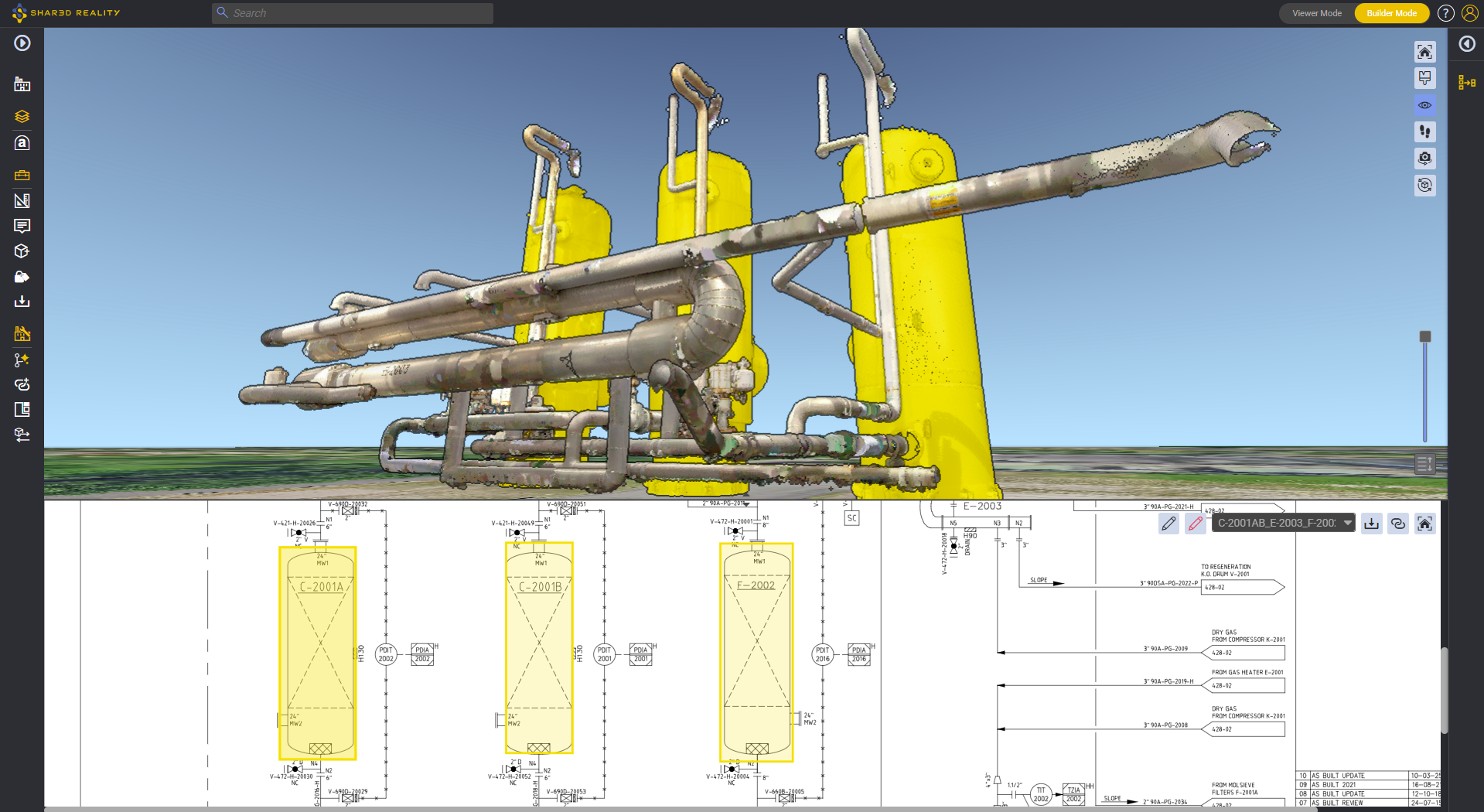
Instead of multiplying on-site visits, teams perform a single, controlled mobile 3D scanning visit to capture site reality. This scan becomes the foundation for detailed virtual walkdowns performed remotely.
This approach allows teams to:
- Eliminate most long and detailed physical walkdowns
- Reduce safety exposure during preparation phases
- Avoid repeated travel to site
- Preserve expert time for analysis rather than logistics
Physical presence is reserved only for final validation or exceptional cases. Most preparation work happens virtually, using verified site reality as the reference.
Step 4. Capture Site Reality Once, Then Reuse It Across Virtual Walkdowns
Field information loses value when it is collected repeatedly through multiple walkdowns and then fragmented across photos, notebooks, and emails.
A Shared Reality workspace consolidates:
- A cloud-based 3D reality model of the site
- Visual context tied to physical locations
- Human-verified observations from the field
This creates a shared reference that planners, engineers, and contractors can access remotely.
Shared Reality does not replace existing workflows.
It supports them by anchoring decisions to verified site conditions.
Learn how operators apply this approach across industrial workflows:
Samp use cases
This approach is also directly linked to inventory reliability and onboarding risk mitigation, as described in:
Inventory Accuracy and Site Onboarding Risk Mitigation.
Step 5. Validate Work Packages During Virtual Walkdowns
Before work packages are finalized, they should be validated against real site conditions using virtual walkdowns based on the 3D reality model.
This includes checking:
- Tool access and lifting paths
- Isolation points visibility
- Equipment identifiers
- Spatial conflicts
Surprises often emerge when crews arrive and realize the work package assumes conditions that do not exist.
Early validation protects both schedule and safety.
Step 6. Align All Stakeholders on the Same Site Truth
Turnarounds involve multiple parties:
- Operations
- Maintenance
- Engineering
- Contractors
Each group often works from a different mental model of the site.
A Shared Reality workspace creates alignment by giving everyone access to the same visual and spatial reference.
This reduces interpretation errors and prevents late-stage disagreements about what is actually on site. Similar misalignments are frequently observed during maintenance preparation when inventory accuracy and site onboarding are not grounded in verified site conditions, a risk explored in detail here:
Inventory Accuracy and Site Onboarding Risk Mitigation.
Step 7. Freeze Plans Only After Reality Is Confirmed
Freezing a plan too early locks in assumptions.
Freezing too late creates chaos.
The correct moment is after:
- Critical areas have been visually verified
- High-risk Surprises have been eliminated
- Stakeholders agree on site conditions
Zero Surprises is achieved before execution begins, not during the turnaround.
Shared Reality Focus
A Shared Reality workspace provides a practical way to reduce Surprises by grounding planning in verified site conditions.
Using a cloud-based 3D reality model, teams can:
- Review as-built conditions remotely
- Contextualize technical information visually
- Support AI-assisted, human-verified identification of inconsistencies
This approach complements digital twin initiatives without replacing engineering systems. It focuses on operational truth, not theoretical design.
FAQ
Why are Surprises so common during turnarounds?
Surprises occur when planning relies on outdated or assumed site conditions instead of verified as-built reality.
How can Surprises be identified before execution?
Surprises can be reduced through targeted field walkdowns, visual capture, and validation of work packages against actual site conditions.
How does Shared Reality help reduce Surprises?
Shared Reality provides a shared, visual reference of site conditions that aligns all stakeholders on the same verified information.
Conclusion & Operational Takeaway
Turnaround failures are rarely caused by poor scheduling.
They are caused by Surprises that should have been identified earlier.
The operational takeaway is simple:
Do not freeze turnaround plans until critical site conditions have been visually verified and shared across all stakeholders.
Zero Surprises is not a slogan.
It is a measurable outcome of disciplined site validation.