Key Takeaways
- Reconciliation failures create a hidden 30% gap between planned and real-world conditions.
- Asset reconciliation is an operational discipline, not a one-time cleanup exercise.
- Most reconciliation errors originate from disconnected field changes.
- A Shared Reality workspace enables continuous, operator-verified reconciliation,
Introduction:
In industrial operations, reconciliation is where trust either exists or collapses.
Most operators assume their technical information is mostly correct. In reality, many sites operate with a 30% gap between planned assets and actual field conditions. This gap directly impacts maintenance execution, safety preparation, shutdowns, and audits.
These blind spots are well documented in industrial maintenance workflows, where disconnected information creates execution risk
Blindspots in Maintenance: 5 Dangerous Gaps in Your P&IDs.
Over time, undocumented field changes accumulate. Valves are replaced. Instruments are rerouted. Temporary fixes become permanent.
Reconciliation is the operational process of bringing plans, systems, and reality back into alignment. When reconciliation fails, every downstream decision carries hidden risk.
A Shared Reality approach provides a pragmatic way to restore reconciliation without rebuilding everything from scratch.
The Real Cost of Poor Reconciliation
Surprises rarely come from complex engineering decisions.
They come from gaps between expected conditions and actual site reality.
Common sources include:
- Equipment removed or modified during past maintenance
- Temporary fixes never reflected in technical information
- Access constraints discovered too late
- Tagging inconsistencies between drawings and the field
Each Surprise forces teams to stop, investigate, and re-align. The result is:
- Lost wrench time
- Emergency engineering decisions
- Schedule compression or extension
- Increased safety exposure
Turnaround planning fails when it is based on assumed conditions instead of verified ones. These blind spots are well documented in industrial maintenance contexts, especially when teams rely on P&IDs that no longer reflect field reality. A deeper analysis of these gaps is available here:
Blindspots in Maintenance: 5 Dangerous Gaps in Your P&IDs.
Why Traditional Reconciliation Approaches Fail
Most reconciliation efforts rely on periodic correction cycles.
Typical approaches include:
- Manual audits every few years
- Engineering-led document updates
- Spreadsheet-based discrepancy tracking
- Isolated laser scans with no operational linkage
These approaches reflect legacy BIM and document-centric thinking, which increasingly fails in live industrial environments
The death of BIM why traditional approaches are failling critical industries.
Field conditions evolve continuously, while reconciliation cycles do not.
1. Start From the Field, Not the System
Reconciliation must begin with actual conditions.
Effective teams prioritize:
- Visual verification of assets
- Operator validation of changes
- Field-first reviews instead of system assumption.
This field-driven approach aligns with how operators already work on site, reducing friction and resistance
https://samp.ai/use-cases/
2. Capture Changes When They Happen
Most reconciliation gaps originate from undocumented changes.
Typical sources include:
- Emergency repairs
- Temporary bypasses that become permanent
- Minor rerouting during maintenance
When changes are captured visually and validated by operators, reconciliation backlogs stop growing. This significantly reduces onboarding and execution risk
https://samp.ai/inventory-accuracy-site-onboarding-risk-mitigation/
3. Connect Visual Context to Technical Information
Reconciliation breaks down when technical information is disconnected from physical context.
Operators need to understand:
- Where an asset is located
- How it connects to surrounding equipment
- Which technical information applies to that specific instance
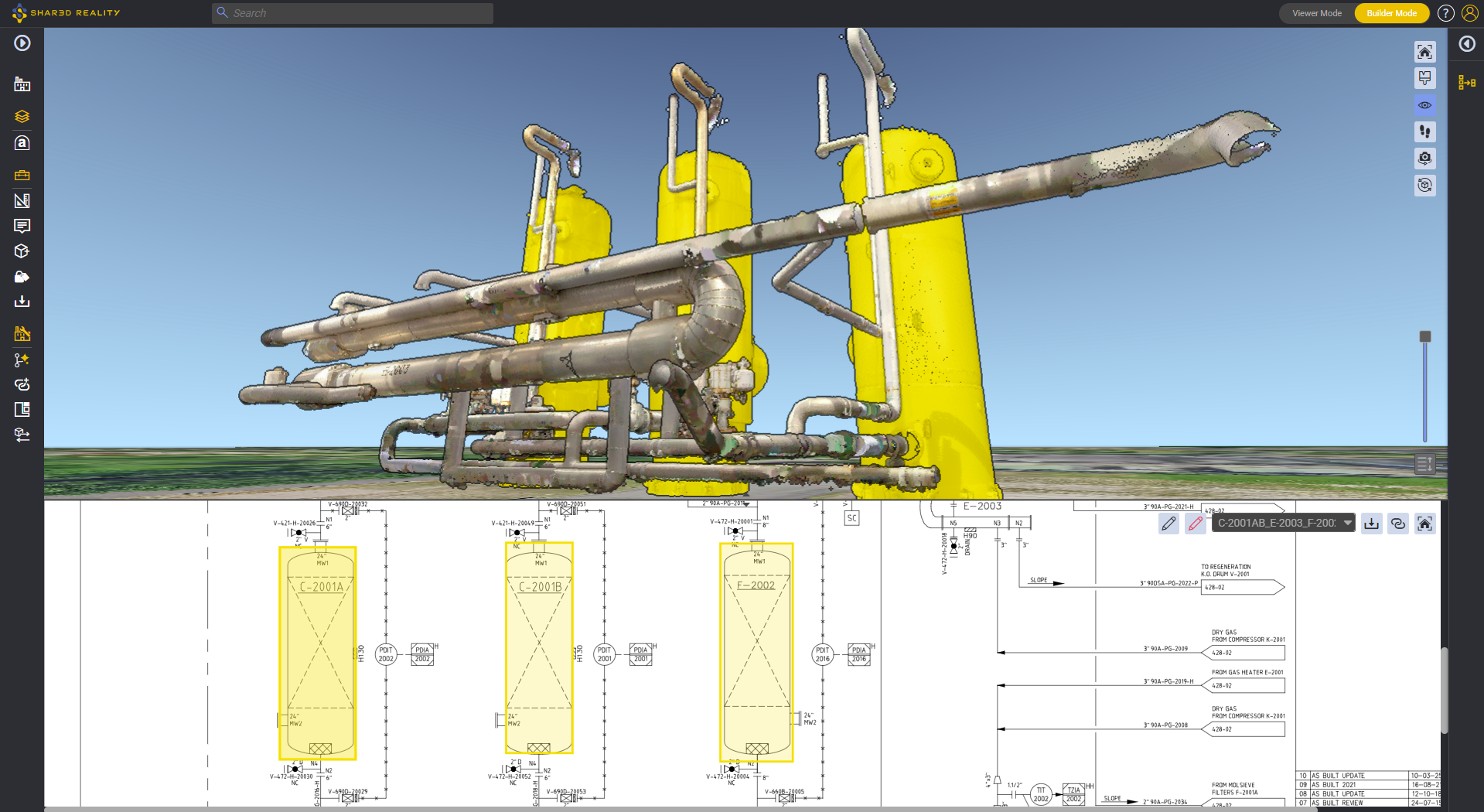
A cloud-based 3D reality model provides spatial context that supports reconciliation without replacing existing systems.
This integration approach is detailed here:
https://samp.ai/integration/
4. Make Reconciliation Continuous, Not Periodic
The most effective reconciliation strategies are continuous.
This means:
- Operators validate information during normal tasks
- Engineers review changes in context
- Maintenance teams confirm as-built conditions before execution
Operators using this approach report fewer surprises during shutdowns and a higher level of trust across teams
https://samp.ai/client-stories/
Shared Reality Focus
A Shared Reality workspace aligns field reality, technical information, and human validation in one environment.
Operators navigate assets using a cloud-based 3D reality model that reflects current conditions. Technical information is accessed in direct spatial context. Discrepancies can be flagged and reviewed without disrupting operations.
AI-assisted capabilities support change detection, but reconciliation remains human-verified. This approach is aligned with how Samp positions Shared Reality as the missing link between AI and the real world
https://samp.ai/samps-shared-reality-the-missing-link-between-agentic-ai-and-the-real-world/
Shared Reality complements existing engineering and maintenance systems by acting as a shared reference layer.
FAQ
What is reconciliation in industrial operations?
Reconciliation is the process of aligning technical information, asset systems, and as-built conditions so teams can trust what they use for decision-making.
Why does reconciliation degrade over time?
Reconciliation degrades when field changes are not captured, validated, and connected back to technical information as part of daily workflows.
How does Shared Reality improve reconciliation?
Shared Reality improves reconciliation by giving operators and engineers visual, field-verified context to validate information against actual conditions.
Conclusion & Operational Takeaway
Reconciliation failures occur when reality moves faster than information systems.
Treat reconciliation as a continuous, field-driven workflow supported by Shared Reality, not as a periodic cleanup project.
This approach restores trust in technical information without massive budgets or disruptive overhauls.