Legacy P&ID Digitization and Reality Capture Synchronization Without CAD Remodeling
In downstream refining, petrochemicals, and offshore oil and gas facilities, the widening gap between physical reality and technical documentation is an acute operational risk. Decades of Management of Change (MOC) cycles, debottlenecking, and emergency maintenance create a compounding rift between 1D asset registers in Computerized Maintenance Management Systems (CMMS) such as SAP PM or IBM Maximo, 2D Piping and Instrumentation Diagrams (P&IDs), and the physical as-built facility. While reality capture technologies like Terrestrial Laser Scanning (TLS) and mobile Simultaneous Localization and Mapping (SLAM) have commoditized 3D data acquisition, they have exposed a massive contextualization bottleneck. Raw .e57 or .las point clouds are geometrically accurate but semantically blind; they are fundamentally just spatial coordinates and RGB values.
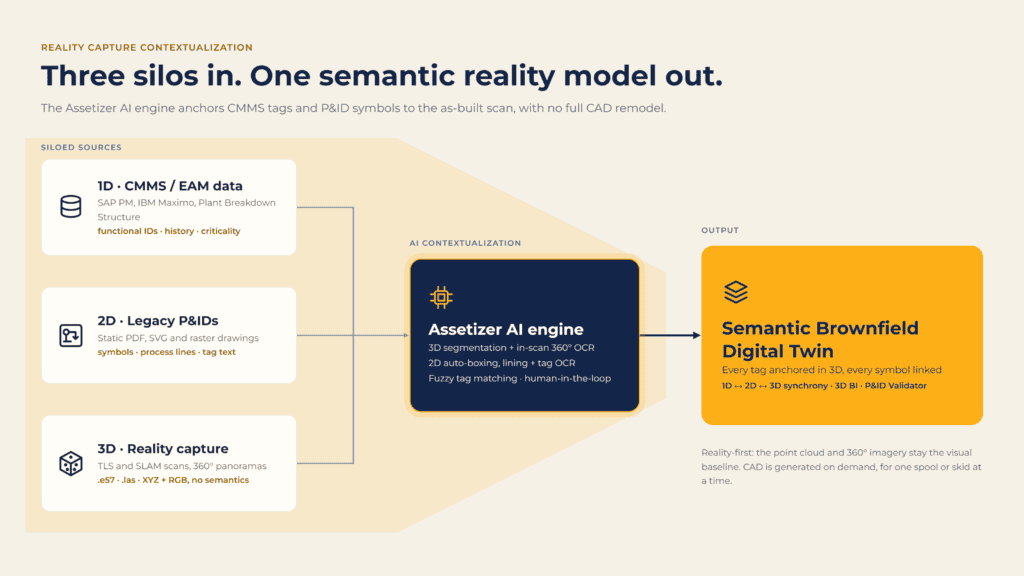
To build a true brownfield digital twin, operators do not just need more points in space; they require reality capture contextualization. They need to seamlessly anchor their CMMS tags, P&ID symbols, and Process Safety Management (PSM) data directly to the physical plant. This article explores how the Assetizer AI engine automates this synchronization, bypassing the heavy, capital-intensive trap of full CAD remodeling in favor of an agile, semantic reality model.
1. The Fallacy of Full CAD Remodeling for Operations & Maintenance
Historically, plant digitization initiatives have relied on manual or semi-automated CAD remodeling. Engineering firms ingest massive point clouds and spend thousands of hours reverse-engineering 3D parametric CAD models (e.g., using PDMS, E3D, or SP3D). While these pristine CAD models are essential for Engineering, Procurement, and Construction (EPC) contractors designing major capital expansions, they represent an unnecessary and expensive overkill for day-to-day Operations and Maintenance (O&M).
What O&M teams, Turnaround (TAR) planners, and inspection engineers actually need is the location of their CMMS and P&ID tags in physical space. They need to know exactly where a specific API 610 pump, control valve, or Condition Monitoring Location (CML) resides on the unit, and they need immediate access to its maintenance history.
Generating a full CAD model from a point cloud strips away the photorealistic reality of the plant, takes months to complete, and becomes instantly outdated the moment a new MOC is executed in the field. Instead, the modern brownfield digital twin relies on reality capture contextualization: keeping the rich, accurate 3D point cloud and 360° panoramic imagery as the visual baseline, and using AI point cloud segmentation to overlay intelligent boundaries and tags directly onto the reality data. If a specific spool or skid requires CAD remodeling for a clash check, that geometry can be generated on-demand from a localized selection in the Shared Reality workspace, rather than attempting to model a 500,000-square-foot facility upfront.
2. 3D Assetizer: AI Point Cloud Segmentation and Spatial Tagging
The foundation of a scalable brownfield digital twin is the 3D Assetizer, a dual-vector AI engine designed to process dense industrial scans.
Geometric Classification and Clustering
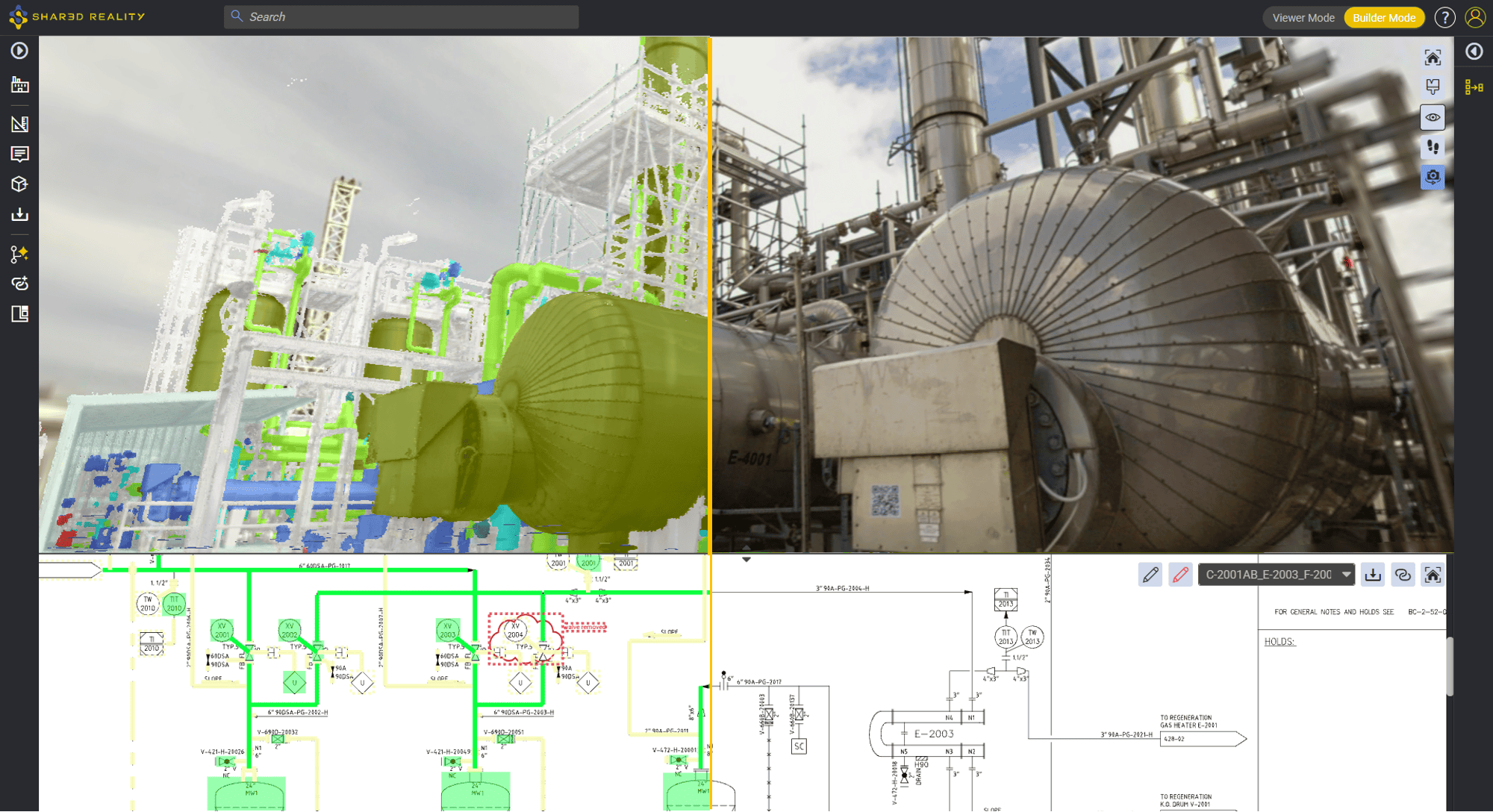
The 3D Assetizer executes AI point cloud segmentation to divide monolithic scans into discrete, interactive geometric clusters. It automatically detects pipes, building structures, and process equipment, generating an auto-inventory directly from the uploaded .e57 file. The machine learning models are trained on specific industrial taxonomies, recognizing cross-industry asset classes such as centrifugal pumps, heat exchangers, control valves, check valves, and dismantling joints. An object is considered supported when its AI detection rate exceeds 80%.
When the point cloud is segmented, every recognized component transitions from a passive collection of points into an active, selectable 3D volume. However, a segmented pump is only useful if it is linked to its specific functional identifier in the CMMS.
In-Scan 360° Spatial OCR
To bridge the gap between segmented geometry and enterprise master data, the 3D Assetizer deploys advanced Optical Character Recognition (OCR) embedded within the 360° panoramic photos captured during the scanning process.
As the AI ingests spherical imagery, it targets physical plant identification markers—stamped stainless steel nameplates, stenciled pipe flow arrows, and wire-hung maintenance discs. Once the text is extracted, the platform applies ray-casting algorithms from the optical center of the 360° camera through the detected label, anchoring the identifier to the exact 3D coordinates in the point cloud.
These extracted alphanumeric strings are instantly reconciled against the facility’s uploaded Plant Breakdown Structure (PBS) or EAM database. Because brownfield labels suffer from corrosion and paint overspray, the system uses fuzzy-matching logic to reconcile minor discrepancies (e.g., reading “IL-101A” instead of “11-101A”) and establish verified spatial tags. This completely automates the reality capture contextualization process, converting a raw spatial scan into an interactive equipment register.
3. 2D Assetizer: P&ID Revalidation and Interactive Overlays
On mature brownfield sites, up to 30% of legacy P&IDs contain physical discrepancies—ranging from abandoned piping legs to missing spectacle blinds. The 2D Assetizer is engineered to resurrect these static .pdf, .svg, or raster documents and integrate them into the digital twin ecosystem.
Intelligent Auto-Boxing and Lining
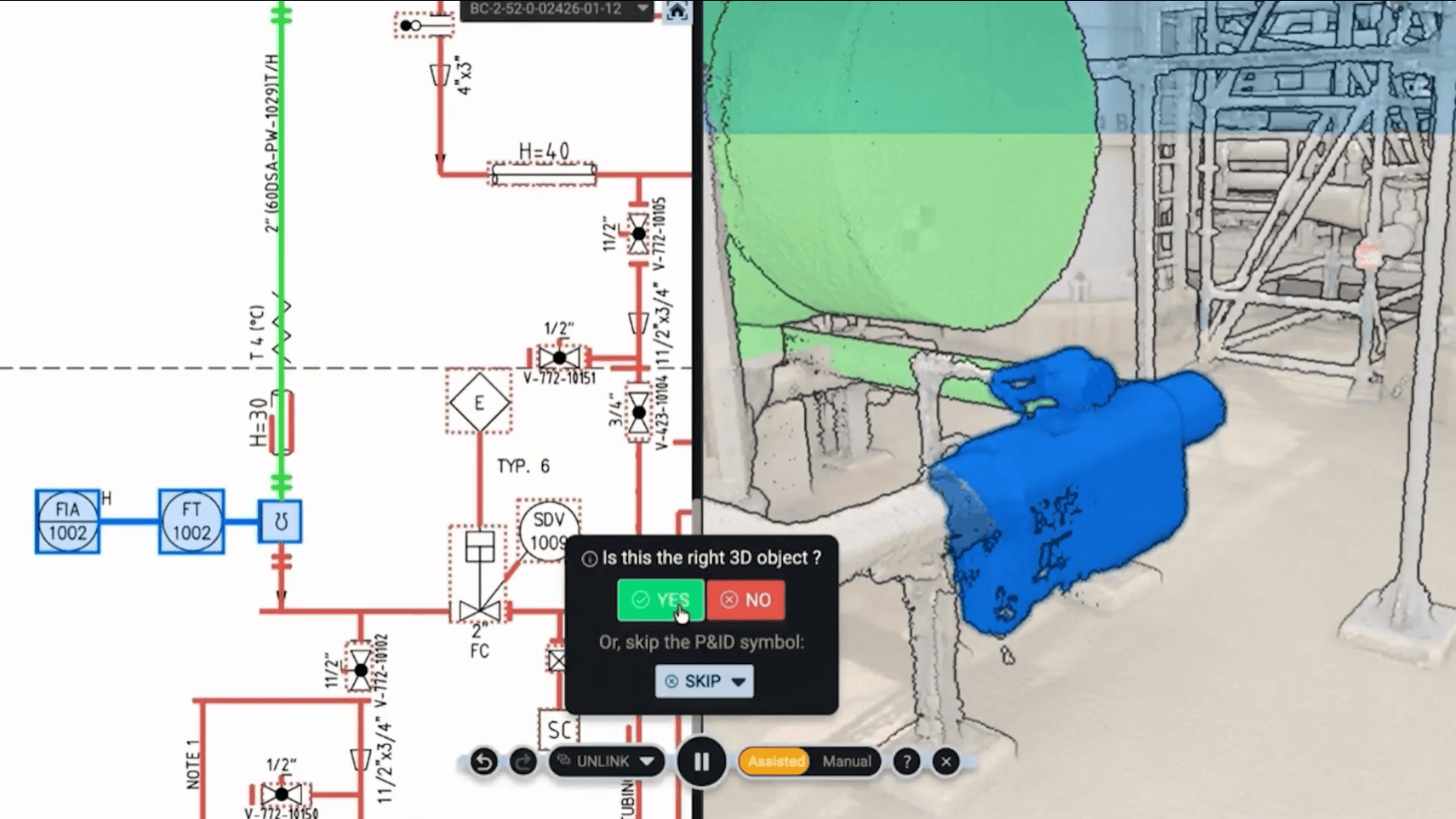
When legacy schematics are uploaded into Shared Reality, the 2D Assetizer runs a fully automated computer vision pipeline. It applies a layer of auto-boxing and lining to intelligently identify industrial symbols (valves, vessels, instruments, flanges) and trace process lines. This process cuts process lines where they cross symbols to allow for granular section selection.
The output is an intelligent layer overlaid on the static drawing, making every symbol and line a selectable object that can be reviewed, redlined, and linked. The AI is trained to ignore non-relevant sections such as drawing borders, title blocks, and legends, focusing strictly on the core process diagram.
Tag Extraction and Automated Linking
Crucially, the 2D Assetizer also executes OCR specifically targeted at the text associated with boxed symbols. It extracts these tag numbers and populates a searchable functional ID list.
If the 1D PBS data is already uploaded, the extracted P&ID tags are automatically consolidated with the 1D master list. The OCR engine includes error management that can correct up to three-character errors to successfully match a degraded P&ID tag to the official CMMS reference. This automation massively accelerates the process of cross-referencing drawings with tabular databases.
4. Tri-Directional Synchrony
With both the 3D reality and the 2D schematics processed by the Assetizer AI engine, the brownfield digital twin achieves full tri-directional synchrony (1D-2D-3D), after validation by a Human In The Loop (HITL).
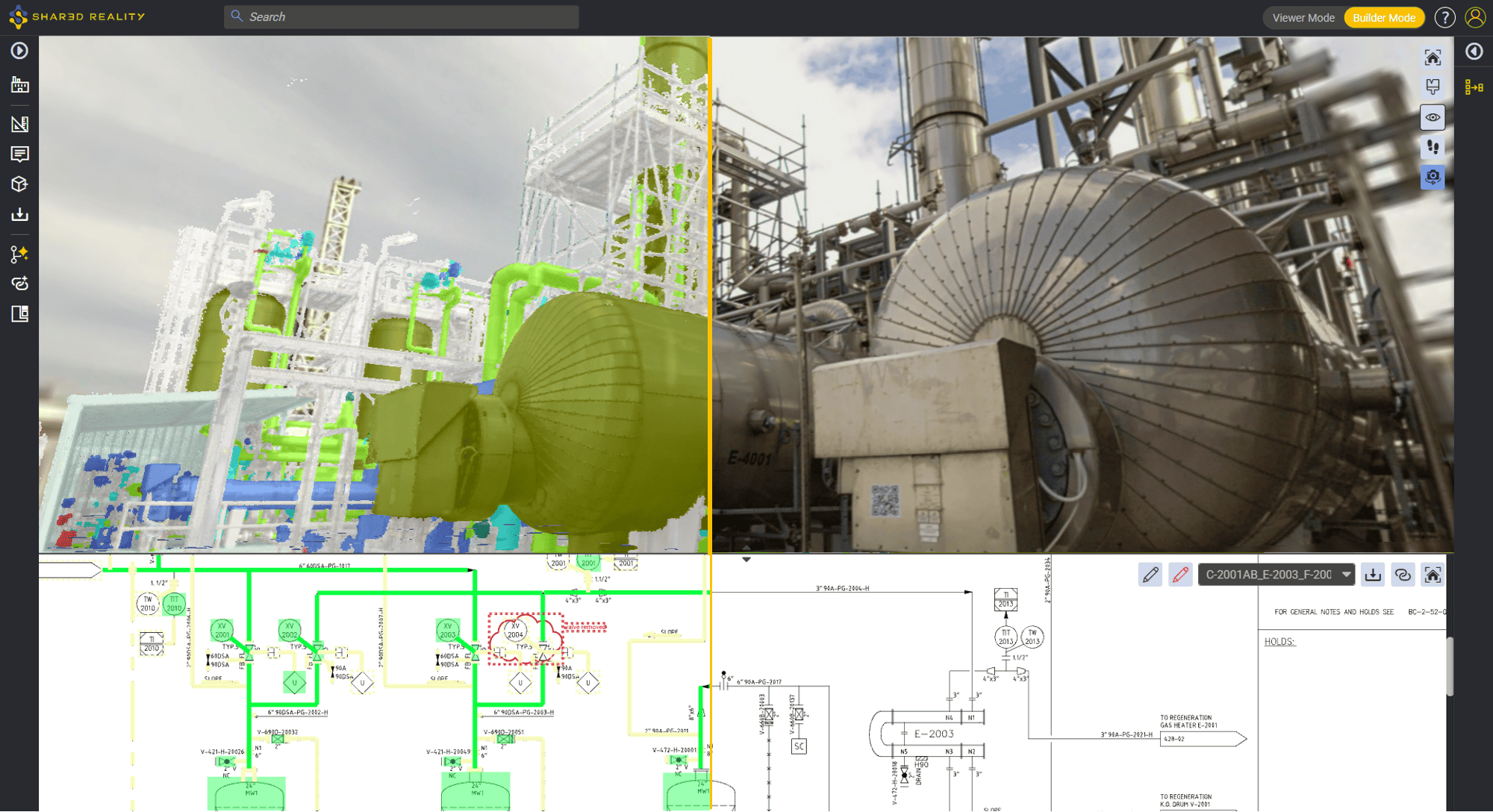
Selecting a tagged control valve or line of piping in the 3D point cloud instantly commands the viewer to open its linked 1D CMMS data and automatically highlight and center that exact valve on the relevant 2D P&ID sheet. Conversely, clicking a symbol or a line on the P&ID flies the 3D camera directly to its real-world physical coordinates.
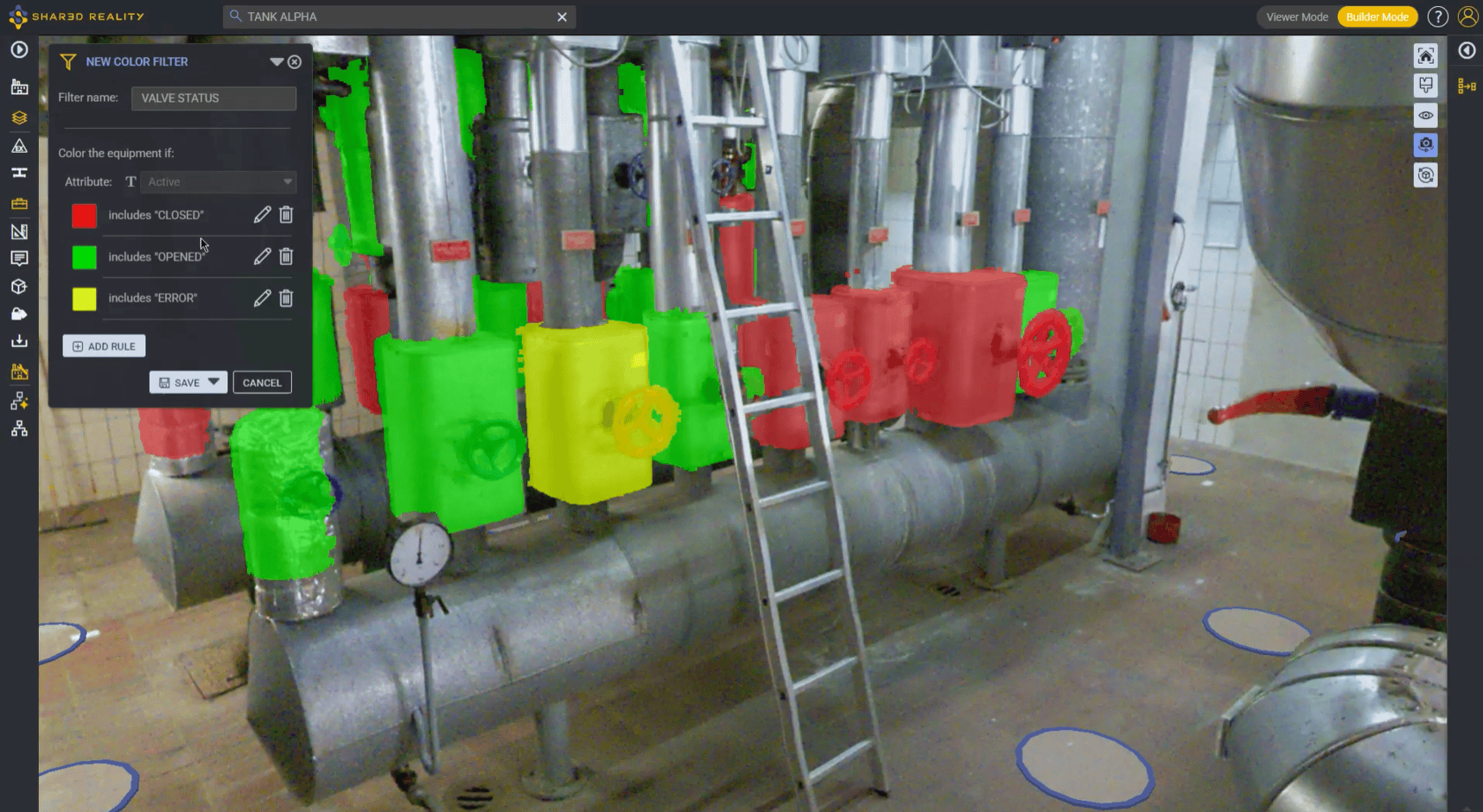
This synchrony unlocks 3D Business Intelligence (3D BI). 3D BI transforms a monolithic 3D scan into an interactive model that can be colorized based on external attribute values imported from ERP or CMMS systems. Engineers can configure customized rules to colorize the 3D scene based on numerical, text, or date data. For example, a maintenance manager can apply a filter that turns all equipment with a “Criticality Rating” of high into red, or color-code pumps based on the number of outstanding days since their last work order. This allows operators to visualize asset health, maintenance backlogs, and process safety statuses directly mapped over the physical reality of the plant.
5. Topological Pipe Crawling and Field Discrepancy Resolution
One of the most powerful applications of this AI-driven reality capture contextualization is automated line-by-line P&ID validation, commonly known as pipe crawling. In process plants, the vast majority of inline components (manual block valves, instrument tees, bypass lines) carry no individual CMMS tags.
Using the P&ID Validator, the system begins at an anchored physical asset identified via 360° OCR (e.g., a tagged vessel). Guided by the 3D Assetizer’s segmentation, the algorithm crawls along the connected pipe run in the 3D space, detecting inline shapes such as flanges, elbows, and manual valves. It then correlates this sequence of detected inline shapes directly against the topological sequence on the linked 2D P&ID.
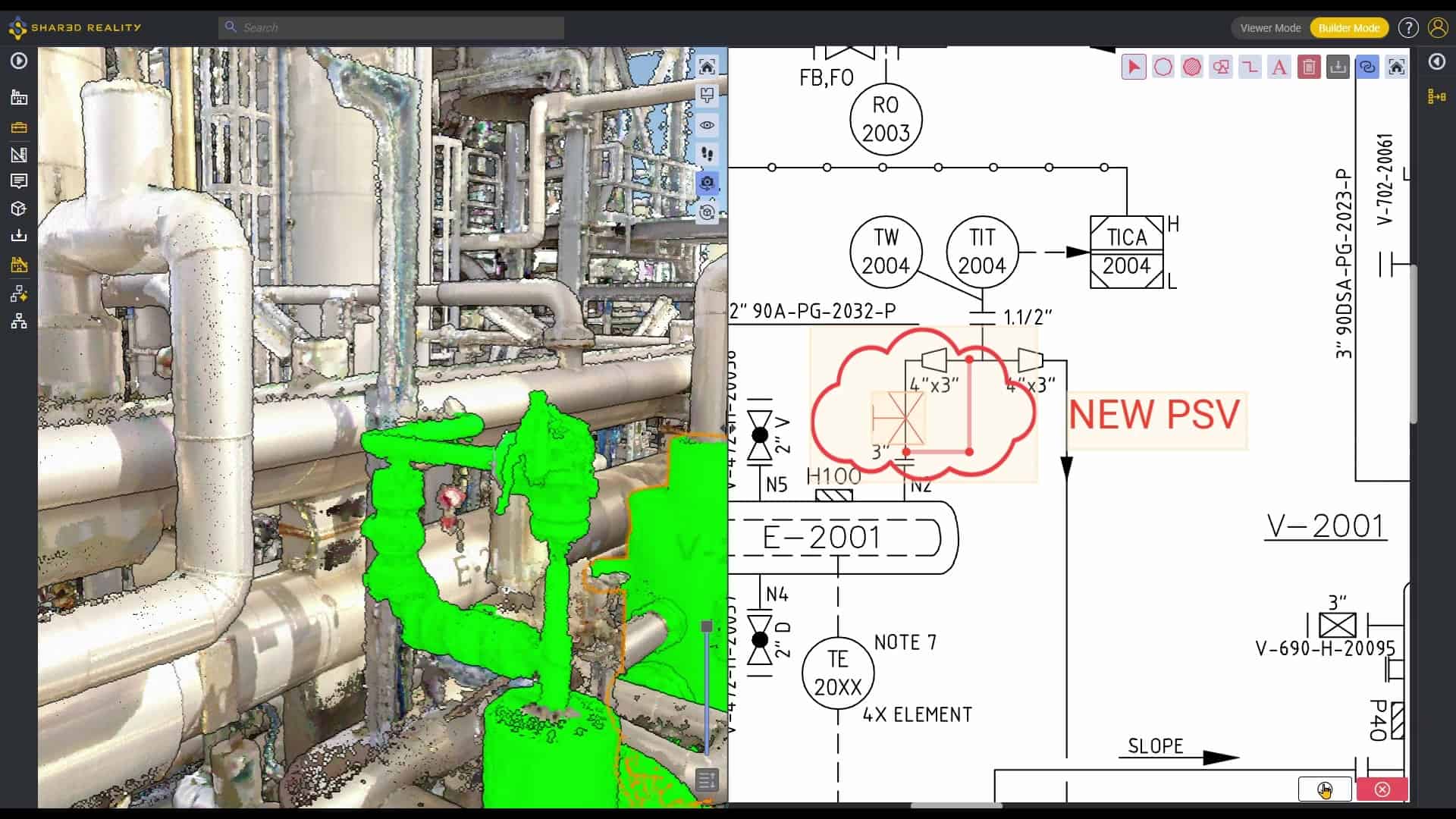
When the algorithm encounters a valve in the 3D scan that does not exist on the P&ID—or vice versa—it flags an immediate as-built discrepancy. Field engineers can then use built-in redlining tools to sketch the undocumented symbol onto the P&ID, link the new 2D graphic to the 3D point cluster, and export an auditable engineering package (PDF/PNG) to update the master drawings. This drastically reduces the time required for pre-TAR walkdowns and hazard study verifications.
6. High-Impact O&M Use Cases for the Semantic Reality Model
Deploying an AI-segmented brownfield digital twin fundamentally shifts the unit economics of asset management across several high-stakes domains.
Turnaround (TAR) & Revamp Optimization
Turnaround planning typically requires months of preliminary field walkdowns to scope mechanical work, locate blind flange insertion points, and plan crane rigging. With a contextualized digital twin, planners can execute virtual job packaging. They can isolate piping systems remotely, verify valve packing access, and confirm positive isolation points (double block and bleed) without entering hazardous operating units. Furthermore, by utilizing the 3D Shape tool to import CAD models (.glb, .gltf, .ifc, .obj) or draw basic geometric volumes (cubes, cylinders), planners can model scaffolding footprints or temporary equipment clearances directly against the as-built scan, mitigating costly scaffolding rework during execution.
Risk-Based Inspection (RBI) and NDT Execution
Under API 570 and API 580/581 programs, locating Condition Monitoring Locations (CMLs) on paper isometrics often leads to field measurement drift. Through reality capture contextualization, inspection points are pinned as 3D annotations directly to the physical pipe extrados or nozzle neck in 3D space. Field technicians equipped with intrinsically safe tablets can navigate directly to the specific coordinate using visual 3D landmarks, eliminating the overhead of searching for poorly marked CMLs in dense process units.
7. Bridge the Gap Between Reality and Engineering Data
The era of maintaining siloed, fragmented engineering data is coming to a close. By leveraging AI point cloud segmentation and in-scan OCR, industrial operators can bypass the costly bottlenecks of CAD remodeling and manual drafting. The Assetizer AI engine provides a reality-first bridge, transforming passive point clouds and static legacy P&IDs into a living, tri-directional brownfield digital twin.
It is time to eliminate the reality-data gap and empower your engineering, operations, and maintenance teams with an interactive, contextualized operational model. Let’s talk about your specific site challenges and explore how automated spatial tagging can streamline your P&ID revalidation, TAR planning, and asset integrity workflows.