Key Takeaways
- The Silent Financial Killer: Inaccurate inventory data is not merely an administrative nuisance; it is a primary driver of operational expenditure (OPEX) leakage, safety incidents, and extended downtime during the critical onboarding phase of industrial sites.
- The Legacy Data Trap: Traditional reliance on paper-based Piping and Instrumentation Diagrams (P&IDs) and static ERP lists creates a “reality gap” where the documented state of a facility diverges significantly from its physical as-built condition.
- Three-Step Mitigation Strategy: To effectively de-risk new site onboarding, operators must transition from manual verification to a digital-first approach: establishing a visual baseline through Reality Capture, unifying data dimensions (1D, 2D, 3D), and enabling continuous context via Shared Reality.
- Samp Solution Architecture: The Shared Reality platform serves as the technological enabler for this transition, utilizing AI to bridge the gap between physical assets and digital records without requiring complex CAD remodeling.
- Proven ROI: Implementation of these steps has demonstrated the ability to reduce survey times by up to 90%, eliminate P&ID inconsistencies, and significantly accelerate the time-to-value for new operational contracts.
Introduction: The Financial Quicksand of the “Blind” Handover
In the high-stakes arena of heavy industry spanning sectors from water treatment and energy generation to chemical processing the moment of “site onboarding” represents a singular point of maximum vulnerability. Whether a contract operator is assuming control of a municipal water facility, or an energy major is acquiring a brownfield refinery, the financial model of the transaction is invariably predicated on a specific set of assumptions regarding the asset base. These assumptions, formalized in the tender and contract, rely heavily on the accuracy of the site’s inventory.
However, industry veterans recognize a pervasive and costly truth: the map rarely matches the territory. The discrepancy between the theoretical inventory listed in an Enterprise Resource Planning (ERP) system or Computerized Maintenance Management System (CMMS) and the actual physical assets standing in the field is often staggering. This phenomenon, widely known as “asset management drift,” is not merely a data hygiene issue; it is a silent killer of profitability and a latent source of catastrophic risk.
When an industrial operator wins a tender or takes over a site, they inherit the facility’s entire operational history. This history includes every undocumented repair, every ad-hoc modification, every “temporary” bypass installed during a night shift five years ago, and every piece of equipment that was cannibalized for parts but never removed from the asset register. If the inventory data is flawed, the new operator is effectively flying blind.
The consequences of this blindness are immediate and severe. Operational teams may find themselves quoting maintenance contracts based on a pump count that is off by 20%. Safety managers may plan critical isolation procedures based on P&IDs that were last updated a decade ago, missing crucial valve changes that could lead to leaks or injuries. Procurement departments may order spare parts for machines that were decommissioned years ago, wasting capital and storage space.
Research into industrial data quality suggests that poor data is responsible for millions of dollars in wasted engineering hours, unplanned downtime, and missed opportunities for optimization. For a new site onboarding, this risk is concentrated in the first 100 daysthe “golden window” where operational margins are established, and the tone for the client relationship is set.
To mitigate these risks, forward-thinking industrial leaders are abandoning the manual clipboard and the static spreadsheet. They are turning to AI-driven Digital Twin technologies and Shared Reality platforms to revolutionize the way inventory is verified, managed, and maintained. This comprehensive report outlines the systemic failures of traditional onboarding and details three critical steps to transform inventory accuracy from a liability into a competitive strategic advantage.
The Economics of Uncertainty: Why Inventory Accuracy Matters
Before examining the technological solution, it is imperative to quantify the problem. In the context of a new site takeover, a major turnaround, or a brownfield redevelopment project, an inaccurate inventory creates a cascading effect of operational friction that erodes value at every level of the organization.
1. The Procurement and Maintenance Gap
The fundamental promise of modern Enterprise Asset Management (EAM) systems is the automation of reliability. However, these systems obey the “Garbage In, Garbage Out” principle. When the inventory list in the CMMS does not match the physical field, automated maintenance schedules fail to deliver value.
- Phantom Assets: Preventive maintenance orders are generated for assets that no longer exist or have been replaced. This wastes technician time often involving travel to remote locations only to report that the equipment cannot be found.
- Ghost Assets: Conversely, critical equipment that exists in the field but is missing from the inventory runs to failure because it is invisible to the maintenance schedule. The cost of reactive, emergency repair is typically 3 to 10 times higher than planned maintenance.5
- Spare Parts Inefficiency: Inventory inaccuracies lead to bloated warehouse stocks. Operators hold parts for machines they don’t have, while lacking critical spares for the machines they do have. This capital is tied up in non-productive assets, directly impacting working capital and cash flow.
2. The Safety and Compliance Trap
Industrial safety relies on a concept of “Shared Reality” a mutual, verified understanding of the environment shared between the control room, the field technician, and the safety manager. If a P&ID shows a valve that has been physically removed, or fails to show a bypass line installed three years ago, standard operating procedures become hazardous.
Lockout-Tagout (LOTO) procedures, which are essential for safe maintenance, require absolute certainty about energy isolation points. Relying on inaccurate drawings to plan a LOTO procedure is a gamble that can result in severe injury or death. Furthermore, maintaining an accurate inventory is often a strict prerequisite for regulatory compliance and certifications such as ISO 55000. Regulatory bodies do not accept “legacy data issues” as a valid excuse for environmental breaches or safety incidents.
3. The “Time-to-Value” Delay
Onboarding a new site traditionally involves a massive mobilization of resources to verify the asset base. Engineers and surveyors must physically walk the lines, redlining paper drawings and manually checking nameplates. This manual validation process is slow, labor-intensive, and prone to human error.
The data collection phase can take 6 to 12 months for a large facility. During this lag time, the operator is managing the site with obsolete data, unable to fully implement optimization strategies or predictive maintenance programs. Accelerating this timeline is crucial for ROI. Every week spent verifying inventory is a week of delayed operational efficiency.
4. The Bid Risk for Contract Operators
For contract operators who bid on public tenders to manage municipal or industrial facilities, inventory risk is a direct threat to margin. If a bid is structured around maintaining 1,000 assets, but the site actually contains 1,200, the operator effectively agrees to maintain 200 assets for free. This “scope creep” destroys profitability. Conversely, adding a massive contingency buffer to cover these unknowns can make the bid uncompetitive.
The Brownfield Reality: Why Legacy Data Fails
The root cause of these challenges lies in the nature of “brownfield” sites. Unlike “greenfield” projects, which are built from scratch with modern digital deliverables, brownfield sites have evolved over decades. They are a patchwork of original designs, retrofits, and undocumented changes.
The Disconnect Between Office and Field
In many industrial organizations, there is a fundamental disconnect between the engineering office and the operational field.
- The Office View: Relies on CAD models, P&IDs, and ERP data. These records are often “as-designed” rather than “as-built.”
- The Field View: Relies on the physical reality. Field technicians know that “Pump B” vibrates excessively or that the manual valve on “Line 4” is seized, but this tribal knowledge rarely makes it back into the digital record.11
The Limitations of Static Documentation
Traditional documentation methods are static. A paper P&ID or a PDF scan is a snapshot in time. The moment a modification is made in the field without a corresponding update to the document, the record becomes obsolete. Over 20 years, thousands of such minor discrepancies accumulate, leading to a “reality gap” that is virtually impossible to close with manual methods.
The High Cost of Manual Verification
Attempting to fix this with manual surveys is prohibitively expensive. It requires sending highly skilled engineers into hazardous environments to perform repetitive data entry tasks. It disrupts operations and exposes personnel to safety risks. Furthermore, manual data entry is error-prone; transposing a serial number or misreading a tag is common, introducing new errors into the system even as old ones are corrected.
Step 1: Establish a Visual Baseline with Reality Capture
The first critical step to de-risking a new contract is to stop relying on legacy documentation and start relying on the incontrovertible truth of the field. This is achieved through rapid Reality Capture.
The End of Manual Walkdowns
Historically, verifying an inventory meant physical walkthroughs. Modern Reality Capture utilizes laser scanning (LiDAR) and photogrammetry to create a millimeter-accurate 3D representation of the facility in a fraction of the time.
- Speed: A site that would take weeks to survey manually can be scanned in a few days. For example, Samp‘s technology allows for the scanning of thousands of square meters per day, drastically reducing the lead time for site assessment.
- Safety: Surveyors spend significantly less time in hazardous zones. Once the scan is complete, subsequent measurements and inspections can be performed virtually from the safety of an office, reducing exposure to industrial hazards.
- Completeness: A laser scanner captures everything within its line of sight. It does not get tired, it does not “skim” over hard-to-reach areas, and it does not bias its collection based on what it thinks is important. It provides an objective, comprehensive record of the site’s condition.
The “Point Cloud” Advantage
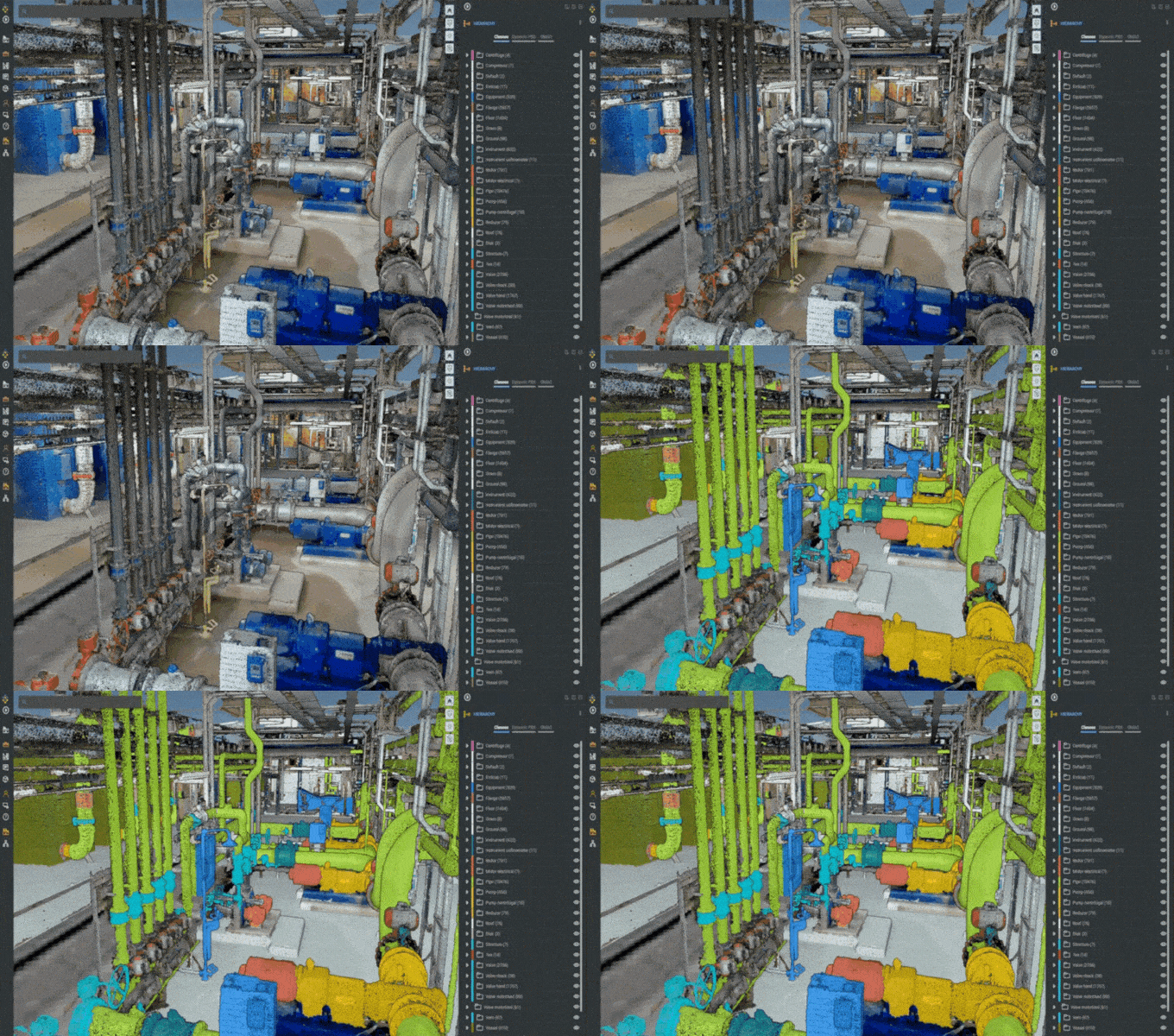
The output of this process is a “Point Cloud” a dense collection of millions of data points that form a 3D model of the facility. This Point Cloud acts as a “Digital Twin” of the physical space. However, a raw point cloud is just geometry; it is not yet an inventory.
The challenge for most operators has been that point clouds are massive files (terabytes of data) that require specialized, high-end workstations to view and manipulate. This technical barrier often creates a new data silo, limiting the utility of the scan to a few CAD specialists while leaving the decision-makers and field teams disconnected.
Democratizing Data with 3D Streaming
This is where Samp differentiates itself in the market. By utilizing advanced 3D Streaming technology, Samp allows these massive 3D datasets to be accessed via a standard web browser on mid-market hardware. This democratization of data ensures that the “Visual Baseline” is accessible to everyone involved in the onboarding process from the boardroom where investment decisions are made, to the control room where daily operations are managed.
Key Insight: The goal of Step 1 is not just to “see” the site, but to freeze the site’s condition in time. This creates an auditable “State 0” at the moment of handover. This “State 0” serves as a definitive record that can protect the new operator from liability for pre-existing conditions or environmental damages that occurred prior to their tenure.
Step 2: Unify Dimensions – The 1D-2D-3D Nexus
Having a 3D model is a powerful visual aid, but it does not constitute an actionable inventory. An inventory is a structured list of assets (1D data) with associated metadata (manufacturer, installation date, maintenance history, capacity). Furthermore, the functional logic of the plant the “how it works” is held in 2D technical diagrams like P&IDs and Process Flow Diagrams (PFDs).
The second critical step is to unify these three dimensions into a coherent whole:
- 1D: The Equipment List / ERP Data (The “What”).
- 2D: The P&IDs and Flowsheets (The “How”).
- 3D: The Reality Capture / Point Cloud (The “Where”).
The Disconnect Problem
In most organizations, these three data types live in rigid silos.
- The Maintenance Team manages the 1D list in SAP or Maximo.
- The Engineering Team manages the 2D CAD files and P&IDs.
- The BIM/Construction Team manages the 3D models.
When these silos don’t talk, inconsistencies breed. A pump might be tagged P-101 in the P&ID, P-101-A in the ERP, and not tagged at all in the 3D model. This misalignment creates confusion during operations and delays during troubleshooting.
The Samp Approach: Contextualizing the Inventory
Samp’s Shared Reality platform uses Artificial Intelligence to bridge these gaps and create a unified data environment.
- AI Tag Extraction: The system ingests existing electronic P&IDs (PDF, SVG, PNG) and uses AI to recognize industrial symbols and extract tag numbers. It converts monolithic image files into interactive, searchable diagrams.15
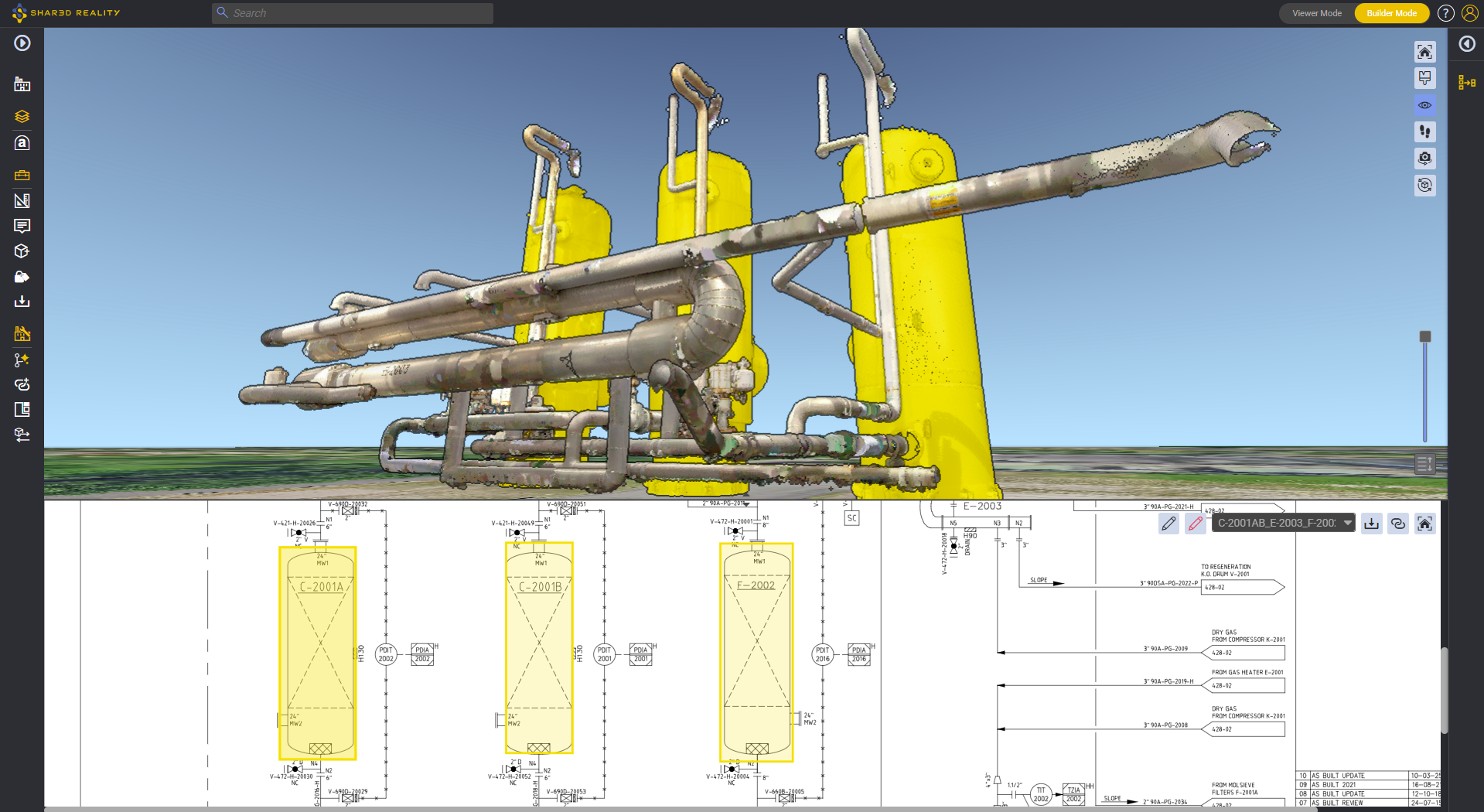
- Dimensional Linking: The platform then correlates these 2D tags with the 3D spatial data. Users can confirm that the valve shown on the drawing corresponds to the specific valve visible in the 3D scan.
- Verification and Discrepancy Flagging: The system highlights discrepancies. For example, if the P&ID shows a valve that is not visible in the 3D scan, or if the 3D scan shows a new bypass line that is missing from the P&ID, these issues are flagged for review.
This process transforms the inventory from a static spreadsheet into a dynamic, multidimensional database. When a user clicks on a pump in the 3D view, they can instantly see its P&ID context (what flows into it, what flows out) and its ERP data (last maintenance date, spare parts inventory).16
Deep Dive: The P&ID Consistency Breakthrough
One of the most powerful applications of this unification is P&ID verification. In a case study with Storengy, a natural gas storage operator, the implementation of Shared Reality allowed them to achieve 0% inconsistencies between their P&IDs and the field reality. This level of accuracy is virtually impossible to achieve with manual redlining methods, where human fatigue and attention lapses inevitably lead to missed errors.
By ensuring that the inventory is consistent across all dimensions, operators can trust their data. This trust is the currency of efficient onboarding. It allows engineers to plan modifications with confidence, knowing that the “as-built” data they are looking at is accurate.
Step 3: Continuous Contextualization & Collaboration
The final step is to operationalize this data. A perfectly accurate inventory is useless if it becomes obsolete the day after it is validated. Industrial sites are living organisms; equipment is swapped, pipes are re-routed, and valves are replaced.
The Risk of “One-Off” Digital Twins
Many “Digital Twin” projects fail because they are treated as a one-time snapshot a “project” rather than a “process.” They are expensive to build and difficult to maintain. Within six months of the initial scan, the “Twin” no longer resembles the “Reality,” and users drift back to their old, siloed ways of working. This leads to the abandonment of the digital tool and a waste of the initial investment.18
Sustainable Updates via Shared Reality
To de-risk onboarding permanently, the inventory system must be living. Samp addresses this through “Continuous Contextualization” and easy update workflows that empower the field team.
- Crowdsourced Data Quality: Field workers are the best sensors in the plant. They walk the site every day. If a technician notices a discrepancy during a routine round such as a pump that has been replaced they can flag it directly in the Shared Reality interface. This transforms data quality from a periodic audit task into a continuous, crowdsourced activity.
- Incremental Updates: When a modification occurs, only that specific area needs to be re-scanned. Samp supports rapid updates via handheld scanners or even smartphones. A field operator can scan a new valve assembly with an iPad, and the AI integrates this new data into the master 3D model in minutes. This keeps the inventory fresh without the need for expensive full-site re-scans.
Empowering the “Extended Enterprise”
Onboarding a new site often involves a flurry of activity from third-party contractors inspectors, maintenance crews, compliance auditors, and regulatory officials. Granting these external parties access to the Shared Reality environment streamlines their work and ensures they are contributing to the inventory accuracy rather than degrading it.
- Secure Access: Samp allows for granular permission settings, ensuring that contractors see only what they need to see. This protects intellectual property and sensitive security data while facilitating collaboration.15
- Collaborative Workspaces: Teams can annotate the 3D model, share “views” of specific equipment, and link to external documentation. This eliminates the need to email massive files or confusing screenshots.
This collaborative approach prevents data silos from reforming. The inventory becomes a shared asset, maintained by the community of users who rely on it.
Sector-Specific Impact Analysis
The value of accurate inventory onboarding varies across industries, but the core need for risk mitigation remains constant.
Water & Utilities
In the water sector, operators are often taking over aging municipal infrastructure. These sites may have documentation dating back 50 years or more.
- Challenge: The gap between global water supply and demand requires efficient modernization of treatment plants. However, reliable technical data is often missing.
- Samp Impact: By rebuilding a digital twin, operators can identify “lost” assets in the distribution network and ensure that modernization plans are based on reality, not old blueprints. This supports continuous data cleansing and regulatory compliance.19
Power & Energy
For energy operators, particularly in Oil & Gas and Nuclear, the stakes are existential.
- Challenge: Life extension programs for nuclear plants or the repurposing of pipelines for hydrogen require absolute certainty about material conditions and asset configurations.
- Samp Impact: Shared Reality supports the management of bi-directional transmission pipelines and complex refinery turnarounds. It allows for the tracking of modifications over decades, ensuring that safety cases remain valid during life extension projects.19
Chemicals & Industrial Gases
These facilities are highly complex, with thousands of interconnected assets operating under high pressure and temperature.
- Challenge: Managing the transformation of large integrated complexes while they remain in operation (brownfield projects).
- Samp Impact: The platform provides a constantly updated view of the facility, allowing production, maintenance, and engineering teams to collaborate on “live” assets. It helps identify risks such as ATEX zones or confined spaces virtually, reducing the need for dangerous physical inspections.20
Case Studies & Proven ROI
The theoretical benefits of this approach are validated by real-world implementations.
Storengy: 0% Inconsistency
Storengy, a subsidiary of ENGIE, manages natural gas storage sites. They faced a significant challenge in preparing for site revamping due to a lack of 3D CAD models and inconsistent documentation.
- Action: Deployed Shared Reality to create a digital twin from 3D scans.
- Result: The project achieved 0% inconsistency between the P&IDs and the field reality. This “no surprise on site” approach allowed for safer and more efficient project execution without rework.17
Trapil: Aggregating Siloed Knowledge
Trapil, an oil pipeline operator, struggled with scattered knowledge across legacy systems.
- Action: Used Shared Reality to aggregate site knowledge into a unified visual workspace.
- Result: The solution was adopted quickly by technical departments, becoming the default tool for preparing interventions. It allowed teams to cross-check infrastructure data in 3D, 2D, and 1D before stepping on site.17
BRL: The “GIS for Production”
BRL, a water infrastructure operator, manages over 100 geographically dispersed sites. They lacked unified visibility and up-to-date documentation.
- Action: Implemented Shared Reality to create a living view of infrastructure, integrating 3D scans with CMMS.
- Result: The system acts as a “GIS equivalent” for production facilities, allowing for the progressive enhancement of asset data. It streamlined the onboarding of new staff and the coordination of contractors across a vast territory.17
ROI Summary Table
Cost Driver | Traditional Onboarding Risk | Samp Shared Reality Benefit |
Survey Costs | High: Requires expensive onsite engineering teams for weeks/months. | Reduced by ~50-90%: Rapid capture and remote verification. |
Engineering Hours | Wasted: Engineers spend 30-50% of time searching for data.14 | Optimized: Instant access to “Single Source of Truth.” |
Procurement | Error-Prone: Ordering wrong parts due to bad ID/Specs. | Accurate: Visual verification of nameplates and specs. |
Safety Incidents | High Risk: LOTO based on bad P&IDs leads to accidents. | De-Risked: 3D verified isolation planning. |
Bid Accuracy | Low: High contingency buffers added for “unknowns.” | Competitive: “Beat the competition” with precise bids.10 |
Time to Value | Slow: Months of manual validation before full ops. | Accelerated: Digital inventory available in days. |
Implementation & Technical Architecture
Implementing a Shared Reality solution does not require a “big bang” IT project. The architecture is designed for agility and security.
Flexible Integration
Samp connects to existing systems of record rather than replacing them.
- Infoboxes: Technical attributes from the CMMS/ERP are displayed directly within the 3D view via customizable “Infoboxes.”
- Deeplinks: The system generates URL-based “deeplinks” for every asset. These can be pasted into SAP or Maximo, allowing a user to jump from a work order directly to the 3D view of the asset.
- API Connectivity: For deeper integration, standard APIs allow for bidirectional data exchange, ensuring that updates in one system are reflected in the other.16
Security and Hosting
Given the critical nature of industrial infrastructure, security is paramount.
- Segregated Environments: Each client is served by a fully segregated cloud environment.
- Data Sovereignty: Clients can choose the region for their data hosting (e.g., AWS regions) to comply with local data residency laws.
- Auditability: All updates and access logs are traced, ensuring full accountability for changes to the inventory.15
The “Onboarding” Workflow for Data
The deployment workflow for a new site follows a logical progression:
- Field Data Capture: Rapid scanning of the facility using terrestrial laser scanners, drones, or mobile devices.
- AI Conversion (Explore): Processing the raw data into a streaming-ready 3D model.
- Asset Data Integration (Enrich): Importing the existing (legacy) asset register and P&IDs.
- Functional Unification (Unify): Using AI to link the 2D tags, 1D list, and 3D objects.
- Continuous Synchronization: Deploying the tool to field teams for daily use and updates.
Conclusion: Turning Data into a Strategic Asset
The era of managing complex industrial assets via spreadsheets, paper rolls, and tribal knowledge is ending. The risks financial, operational, and legal are simply too high in a modern regulatory and economic environment. Inaccurate inventory data is a liability that compounds with every day of operation, draining resources and increasing the likelihood of failure.
By implementing the three steps outlined in this report Reality Capture for a visual baseline, Dimensional Unification for data integrity, and Continuous Contextualization for operational sustainability industrial leaders can fundamentally transform their site onboarding process. They can strip away the uncertainty of brownfield assets, revealing a clear, actionable picture of their operation.
Samp Shared Reality provides the technological infrastructure to make this transition seamless. It bridges the gap between the “As-Designed” world of the engineer and the “As-Built” world of the operator. For decision-makers, the ROI is clear: lower survey costs, fewer procurement errors, safer operations, and the confidence that comes from knowing exactly what you own.
In the competitive landscape of industrial operations, data accuracy is no longer just a support function; it is a core business driver. Don’t let bad data define your next contract. Start your journey toward inventory accuracy today.