Why Documentation Integrity Matters for Process Safety
Every process facility changes.
A valve is replaced during a turnaround. A line is rerouted during a revamp project. An instrument is upgraded. A temporary bypass becomes permanent. Individually, these changes may appear routine. Over time, however, they can create a growing gap between what exists in the field and what is represented in engineering documentation.
For facilities covered by OSHA’s Process Safety Management (PSM) standard, that gap is more than an engineering concern. It directly affects the quality of the information used to operate, maintain, modify, and assess the safety of the facility.
As industrial assets age and experienced personnel retire, keeping technical documentation aligned with reality has become one of the most persistent challenges facing process industries today.
What is OSHA's Process Safety Management (PSM) Standard?
The Occupational Safety and Health Administration (OSHA) Process Safety Management standard, commonly referred to as PSM (29 CFR 1910.119), is a U.S. regulation designed to prevent catastrophic releases of hazardous chemicals in industrial facilities.
Unlike regulations focused on personal safety or routine workplace hazards, PSM addresses major process safety risks – events such as fires, explosions, toxic releases, and other incidents capable of causing severe injuries, fatalities, environmental damage, or significant asset losses.
The regulation applies to facilities that handle specific quantities of highly hazardous chemicals and is particularly relevant to industries such as:
- Oil & Gas
- LNG and Gas Processing
- Petrochemicals
- Refining
- Chemical Manufacturing
- Industrial Gases
- Pharmaceuticals
- Specialty Chemicals
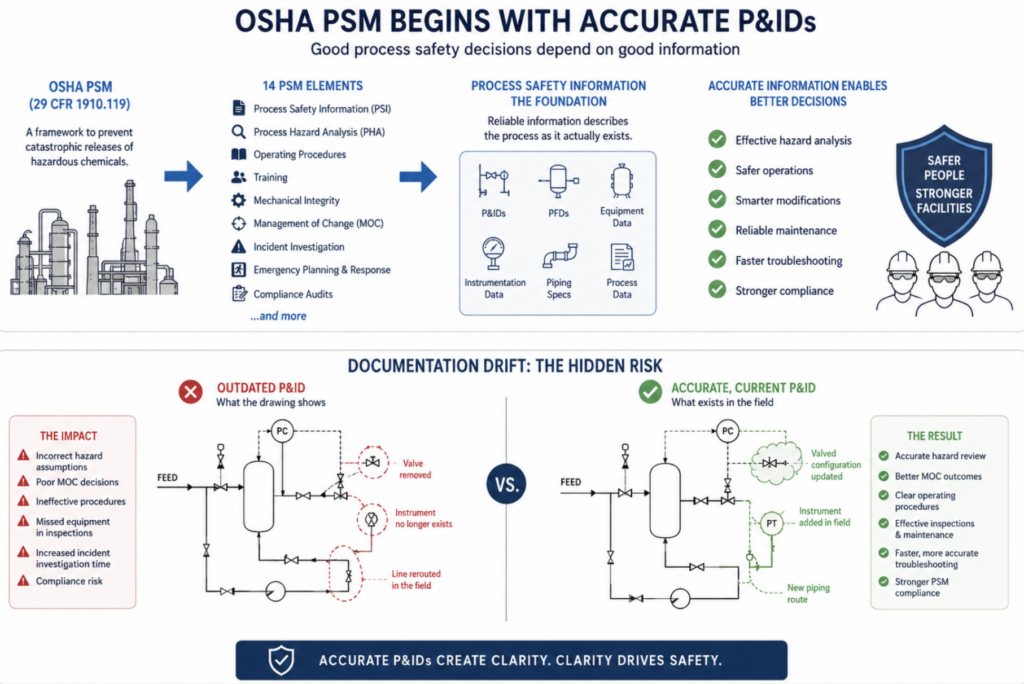
PSM is built around 14 interconnected elements that collectively establish a framework for safe operation throughout the lifecycle of a facility.
These elements include:
- Process Safety Information (PSI)
- Process Hazard Analysis (PHA)
- Operating Procedures
- Training
- Mechanical Integrity
- Management of Change (MOC)
- Incident Investigation
- Emergency Planning and Response
- Compliance Audits
The principle behind the regulation is straightforward:
Organizations cannot safely operate, maintain, or modify a process if they do not have an accurate understanding of how that process is designed and configured.
This is why Process Safety Information sits at the foundation of the entire PSM framework.
Process Safety Information: The Foundation of PSM
Before a facility can conduct a hazard analysis, evaluate modifications, maintain critical equipment, investigate incidents, or train personnel, it must first establish and maintain documentation that accurately describes the process.
This information typically includes:
- Process Flow Diagrams (PFDs)
- Piping and Instrumentation Diagrams (P&IDs)
- Equipment specifications
- Instrumentation and control documentation
- Piping specifications and isometric drawings
- Process chemistry information
- Design and operating limits
These documents become the common reference used by engineering, operations, maintenance, projects, contractors, procurement teams, and HSE personnel.
When different groups are working from different assumptions, misunderstandings become inevitable.
Why P&IDs Are So Critical
Among all process safety documents, P&IDs hold a unique position.
A P&ID does much more than show equipment and piping. It represents how the process is intended to operate. It identifies process equipment, instruments, control loops, isolation points, safety devices, and critical process connections.
As a result, P&IDs are routinely used during:
- PHA and HAZOP studies
- Management of Change reviews
- Lockout/tagout preparation
- Maintenance planning
- Incident investigations
- Operator training
- Capital project execution
- Compliance audits
For many teams, the P&ID is the first document consulted when making operational or engineering decisions.
When the drawing no longer reflects reality, uncertainty enters every activity that depends on it.
The Challenge of Documentation Drift
Most operators have encountered it.
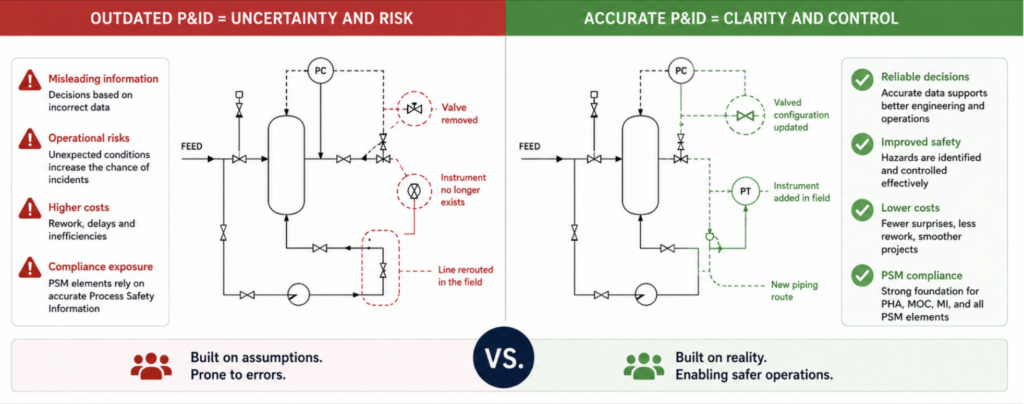
A drawing shows a valve that was removed years ago.
An instrument exists in the field but is missing from the documentation.
A piping route was modified during a shutdown but never updated on the master drawing.
These discrepancies rarely arise because people neglect their responsibilities. They are a consequence of operating complex facilities that continuously evolve over decades.
Projects are completed. Equipment is replaced. Temporary modifications become permanent. Documentation updates are delayed. Knowledge becomes fragmented between departments.
Over time, confidence in the documentation begins to erode.
The impact extends far beyond compliance:
- Engineers spend additional time verifying existing conditions before starting design work.
- Maintenance teams perform extra site visits to confirm equipment configurations.
- Contractors encounter unexpected conditions during execution.
- Operators rely increasingly on personal experience rather than documented information.
- Hazard review teams spend valuable time determining what actually exists in the field.
Eventually, a simple but important question emerges:
Can we trust the documentation?
Where Inaccurate P&IDs Impact PSM
The consequences of outdated drawings are often felt across multiple PSM elements.
Process Hazard Analysis (PHA)
A hazard review is only as effective as the information used during the study. If process drawings do not reflect current conditions, teams may evaluate scenarios based on incorrect assumptions.
Management of Change (MOC)
Every modification should be assessed against the existing facility configuration. When documentation is outdated, identifying the true impact of a proposed change becomes more difficult.
Mechanical Integrity
Inspection and maintenance programs depend on knowing what equipment exists, where it is located, and how it is connected. Documentation gaps can create inefficiencies and increase the risk of overlooked assets.
Operating Procedures
Procedures frequently reference equipment, valves, instruments, and process conditions shown on P&IDs. If drawings and procedures diverge, confusion can occur during routine or abnormal operations.
Incident Investigation
Understanding what happened after an event requires an accurate representation of the system involved. Investigations become more challenging when engineering records do not match actual field conditions.
In other words, documentation accuracy is not simply an engineering issue—it supports the effectiveness of the entire process safety program.
Why PHA Revalidations Often Reveal Documentation Issues
Many organizations first become aware of the extent of documentation drift during their five-year PHA revalidation cycle.
A HAZOP or PHA team expects the P&ID to provide a reliable basis for reviewing hazards and safeguards. Yet discrepancies frequently emerge between the drawing and the physical installation.
When this happens, valuable workshop time is spent validating the current configuration instead of analyzing risk.
The discovery itself is often useful because it highlights areas where engineering records need attention. However, it also demonstrates how difficult it can be to maintain alignment between documentation and reality over the lifetime of a facility.
For this reason, many operators are treating documentation integrity as a strategic component of process safety rather than an occasional compliance exercise.
The Limits of Traditional P&ID Walkdowns
Historically, maintaining drawing accuracy meant sending engineers or contractors into the field to perform P&ID walkdowns.
This approach remains effective and, in many situations, necessary. However, it can become increasingly difficult as facilities grow larger and more complex.
Large refineries, LNG terminals, petrochemical complexes, gas processing plants, and pipeline networks may contain tens of thousands of assets spread across extensive sites.
Verifying documentation often requires:
- Significant field time
- Permit coordination
- Safety precautions in operating areas
- Contractor support
- Multiple review and drafting cycles
The result is typically a large effort that produces a snapshot of the facility at a specific point in time.
Yet the facility continues evolving as soon as the verification campaign is complete.
By the time updated drawings are approved, new modifications may already have occurred.
Moving from Periodic Verification to Continuous Revalidation
Rather than relying exclusively on periodic validation projects, many operators are exploring more continuous approaches to maintaining engineering records.
Advances in reality capture, digital twins, and AI-assisted workflows are making it possible to compare drawings against current field conditions more efficiently and more frequently.
The objective is not to eliminate field verification. Physical validation will always remain essential for critical decisions.
The objective is to reduce the effort required to identify discrepancies, prioritize corrections, and maintain confidence in engineering records over time.
Instead of treating documentation updates as a major project every few years, organizations can progressively improve information quality as part of everyday operations.
© Samp: Reality and Documentation Side by Side Shared Reality
Turning Everyday Observations into Better Documentation
Maintenance teams, inspectors, contractors, project engineers, and operators routinely discover inconsistencies between documentation and field conditions.
Historically, many of these findings remained buried in reports, emails, spreadsheets, or personal notes.
Today, operators are increasingly looking for ways to capture these observations as part of a structured improvement process.
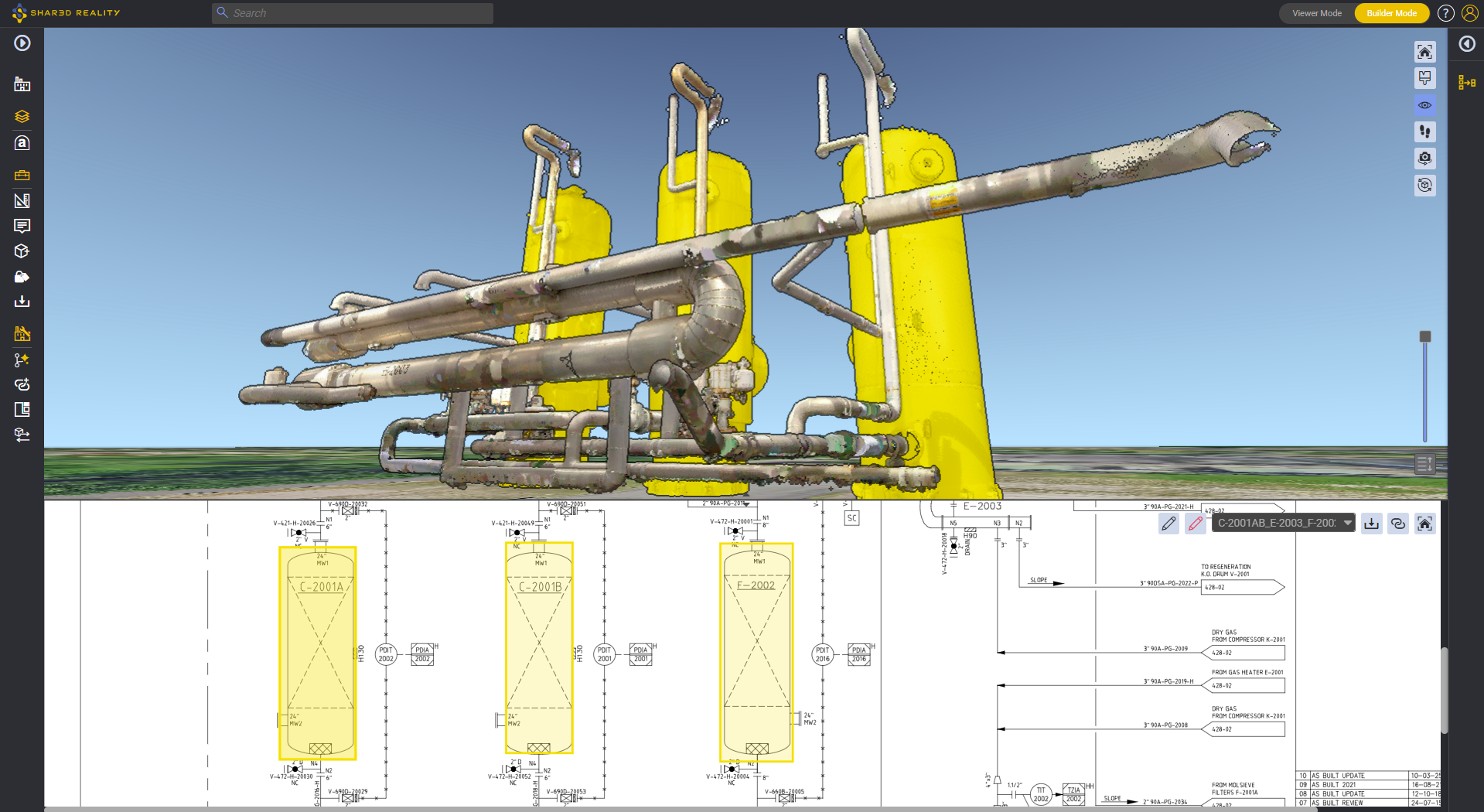
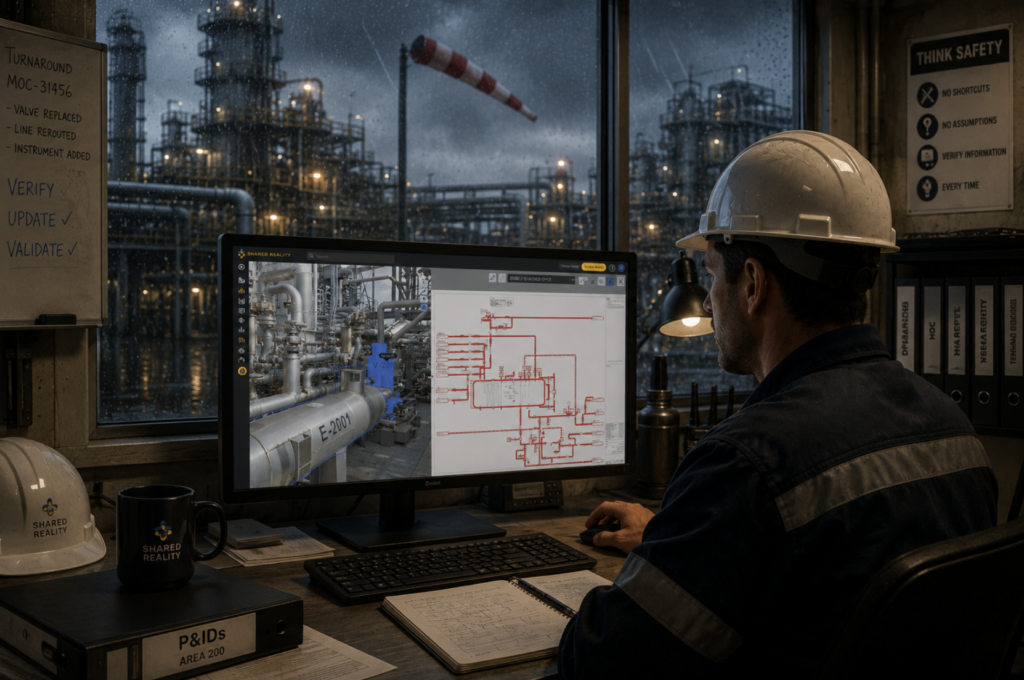
Some organizations are using Shared Reality environments, reality capture technologies, and AI-assisted workflows to compare P&IDs with current field conditions, identify discrepancies earlier, and support ongoing revalidation efforts.
The objective is not to replace engineering judgement or Management of Change processes. It is to make discrepancies easier to identify, review, and resolve before they become larger operational or safety concerns.
Over time, each verified correction contributes to a more reliable representation of the facility, benefiting engineers, operators, maintenance teams, contractors, and safety professionals alike.
Beyond Compliance
For many organizations, PSM compliance is the initial driver for improving documentation quality.
The benefits, however, extend well beyond regulatory requirements.
Reliable engineering records help organizations:
- Reduce project uncertainty
- Improve maintenance preparation
- Accelerate troubleshooting
- Support safer decision-making
- Strengthen Management of Change processes
- Increase confidence during audits and reviews
- Reduce unnecessary field exposure
As facilities become older, workforces become more distributed, and institutional knowledge becomes harder to retain, maintaining trusted engineering information becomes increasingly valuable.
Conclusion
OSHA’s Process Safety Management standard begins with Process Safety Information for a simple reason: every process safety activity depends on understanding the facility as it actually exists.
P&IDs, PFDs, equipment records, and related engineering documents are not merely compliance artifacts. They are operational assets that support daily decisions across engineering, maintenance, operations, projects, and safety.
Maintaining them has never been easy. Yet as industrial infrastructure continues to evolve, the importance of keeping documentation aligned with reality will only increase.
The question is no longer whether documentation integrity matters.
The question is how organizations can maintain that integrity efficiently, consistently, and continuously throughout the life of the facility.