For industrial companies, scaling a digital initiative across multiple facilities can quickly sound more complicated than it needs to be. Discussions move towards enterprise architectures, data harmonisation, system integrations and large-scale modelling programmes before the first operational teams have had an opportunity to see meaningful value.
Shared Reality offers a more practical route.
The principle is straightforward: establish an accurate representation of the facility as it exists today, connect the information that teams already use, and make that combined context accessible to the people who need it. From there, the environment can be enriched and extended as operational needs evolve.
This is particularly relevant for brownfield facilities. Years of modifications, maintenance and ownership changes often mean that useful information is distributed across P&IDs, asset registers, maintenance systems, engineering documents and the knowledge of people working on site. Not all of it will be complete or perfectly aligned with what is physically installed.
That does not have to prevent an organisation from starting.
In the recent webinar Shared Reality at Scale, we explored how industrial operators can establish Shared Reality at one facility and progressively extend the approach across teams, use cases and sites. Nine lessons stand out.
1. Start with an operational need that already exists
A successful deployment does not need to begin with an ambitious digital twin programme. In many cases, the best starting point is a familiar operational activity that is already consuming time, resources or engineering effort.
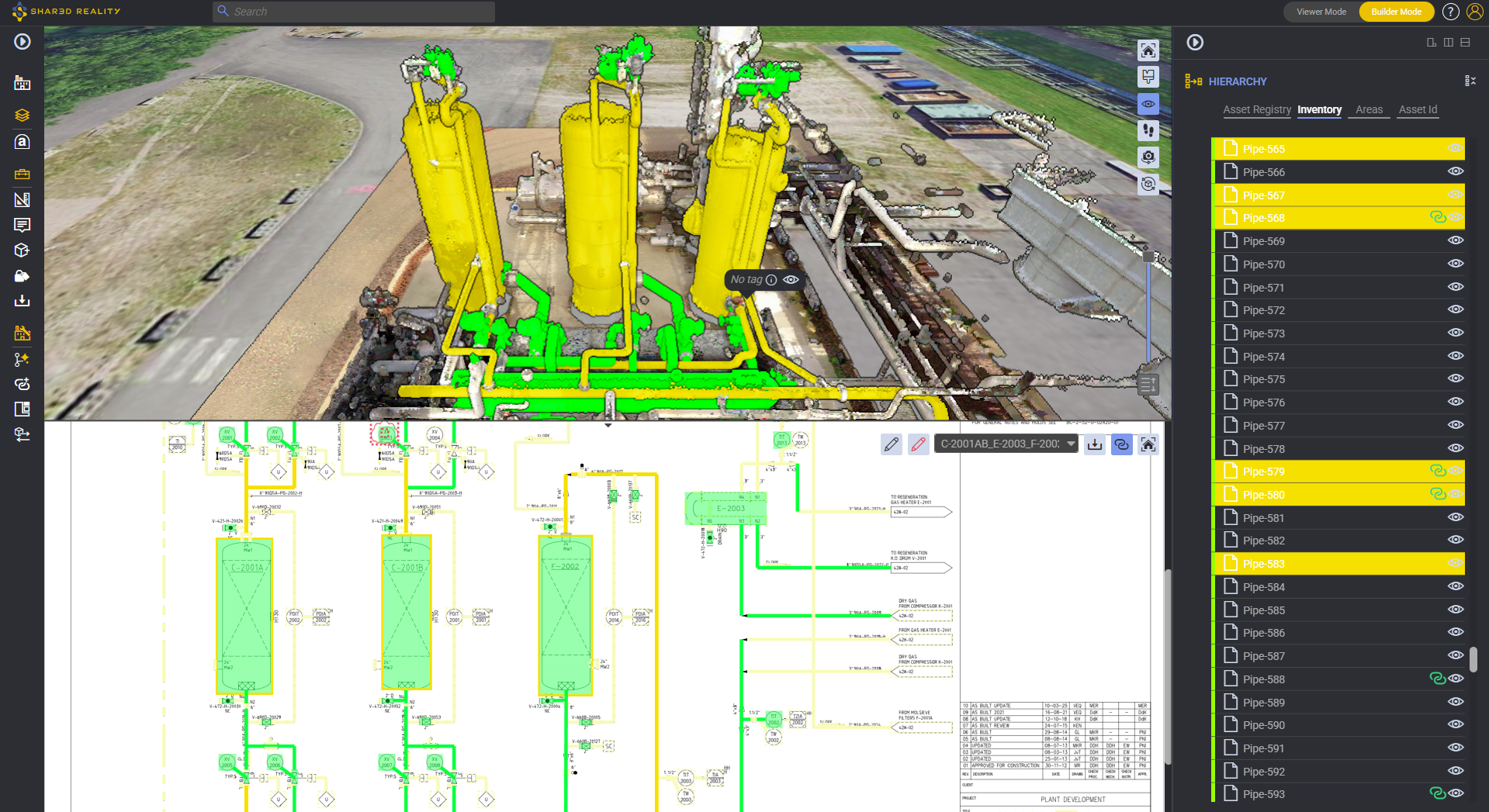
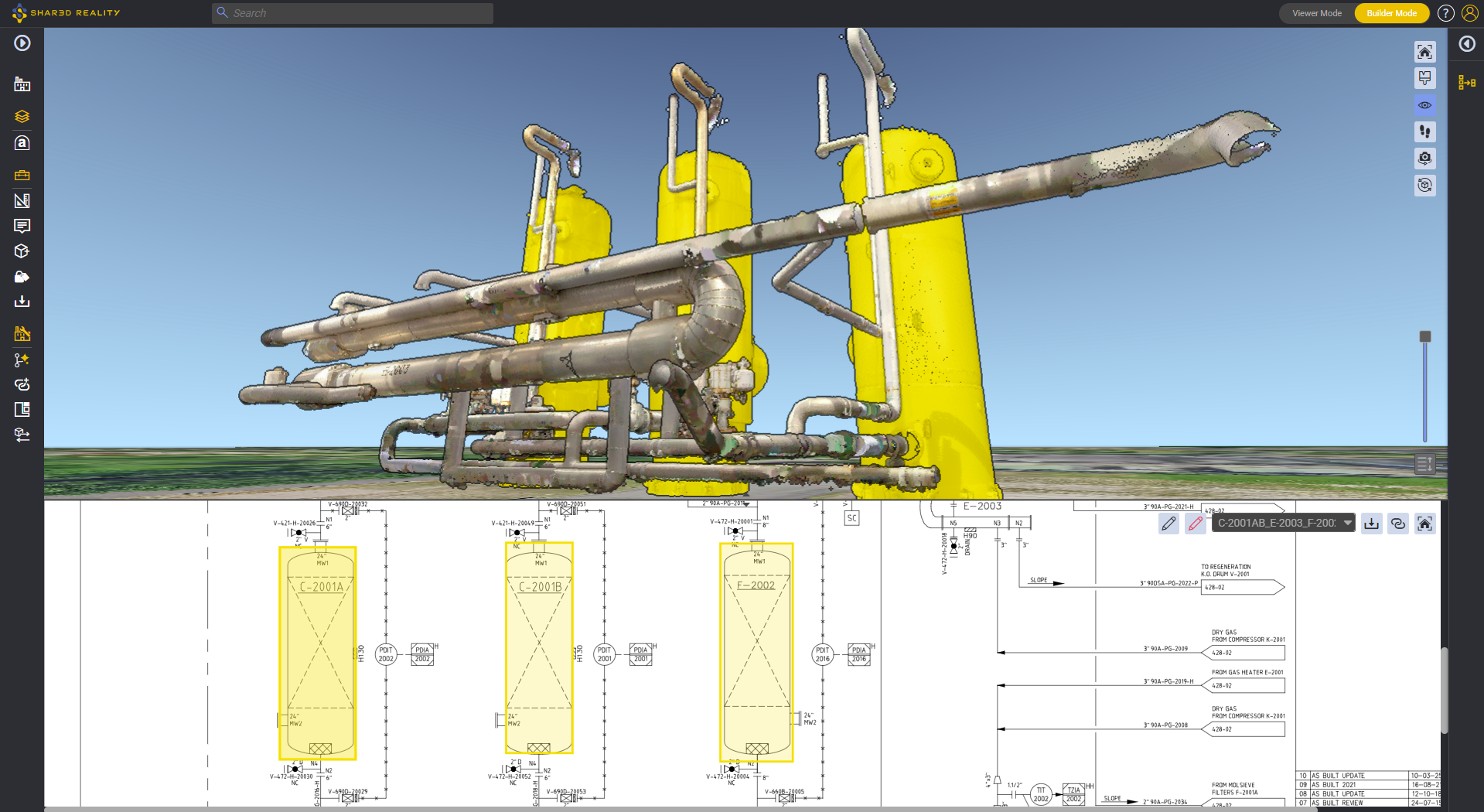
Technical asset inventory is one example, particularly when taking responsibility for a brownfield facility where information is incomplete. P&ID revalidation is another, as teams need an efficient way to compare engineering documentation with what is actually installed. Procurement teams can provide bidders with better site context before quotations are prepared, while maintenance and engineering teams can use Shared Reality to prepare interventions, revamps and turnarounds remotely.
These use cases are effective starting points because they do not require the organisation to invent a new process simply to justify the technology. The work is already taking place. Shared Reality provides a clearer and more accessible way to understand the facility while doing it.
This also makes the first deployment easier to evaluate. Instead of measuring success by how much of the plant has been digitised, operators can look at whether a real workflow has improved.
2. Let the first use case define what you need
Once a starting use case has been selected, its requirements can determine the scope of the first deployment.
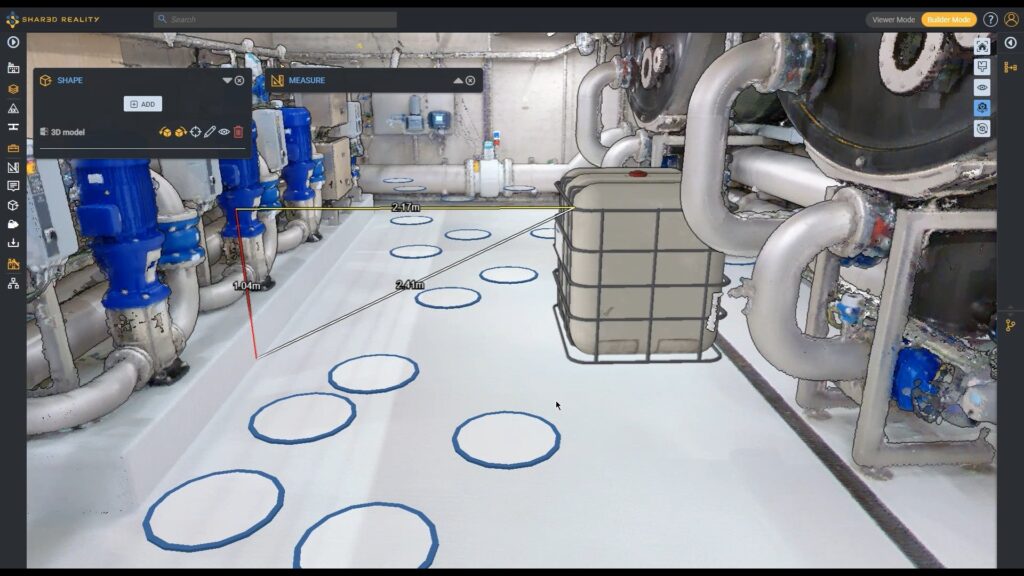
A maintenance planner preparing an intervention, for example, may need to inspect the surrounding area, understand access constraints, identify nearby equipment and take measurements. An engineering team revalidating a P&ID will need a different combination of visual context and asset information. A contractor preparing a tender may primarily need enough reliable site context to understand the conditions in which the work will take place.
None of these scenarios requires every piece of information about the facility to be available from day one.
This is an important principle for scaling Shared Reality. Rather than defining an exhaustive digital scope upfront, the environment can grow in response to actual use. The first deployment establishes what information is genuinely useful, which connections matter and how people interact with the facility remotely.
When the approach is extended to another workflow or site, those lessons can be reused.
3. Begin with the physical reality of the facility
Brownfield facilities rarely remain exactly as they were originally designed. Equipment is replaced, pipework is modified, projects change layouts and maintenance activities alter the installation over time. Engineering information remains essential, but different sources may reflect different moments in the facility’s history.
Reality capture provides a simple way to establish a current reference.
Mobile capture systems combining LiDAR and panoramic imagery can record both the geometry and visual appearance of an industrial environment while moving through the facility. During the Shared Reality at Scale webinar, we discussed typical capture productivity of approximately 5,000 to 10,000 m² per person per day, depending on site density and complexity.
For operators, the important point is not simply the speed of scanning. It is what that speed makes possible.
Instead of spending months reconstructing the current state of a facility from historical information, teams can establish an accurate view of what is physically present and then connect existing engineering and asset information to it.
The digital journey therefore starts from the facility itself.
4. Make captured reality usable at asset level
A detailed 3D capture contains valuable information, but a raw scan is not necessarily the way an engineer, maintenance planner or operator wants to interact with a plant.
Industrial teams work with assets and systems. They want to identify a valve, locate a pump, understand where a pipe runs or inspect the equipment surrounding an intervention.
This is where AI-assisted assetization plays an important role in Shared Reality.
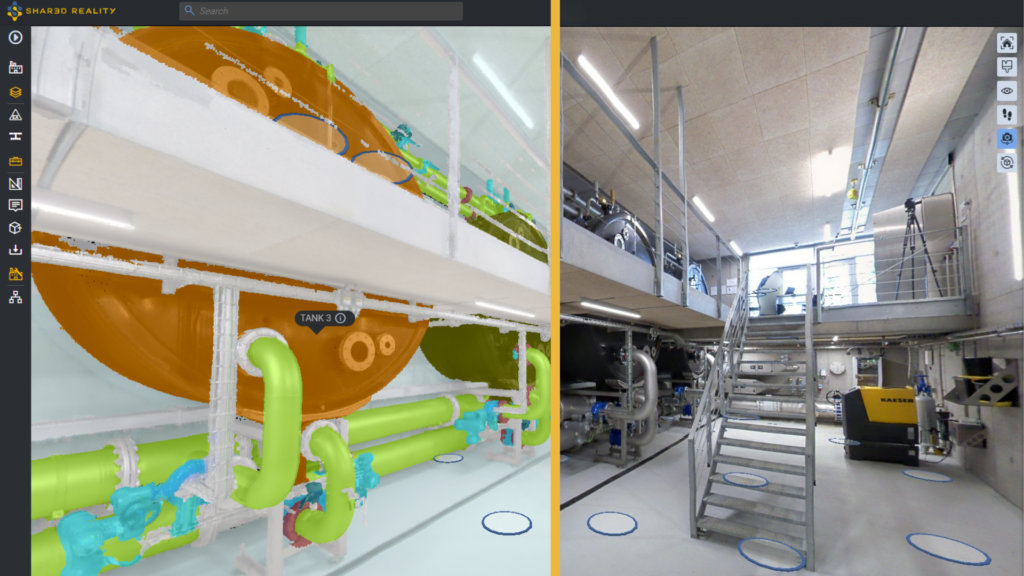
Assetization transforms the captured environment from a monolithic representation into individual, interactive industrial objects such as pipes, valves and flanges. In the workflow presented during the webinar, this processing typically takes one to four hours, including for large industrial environments.
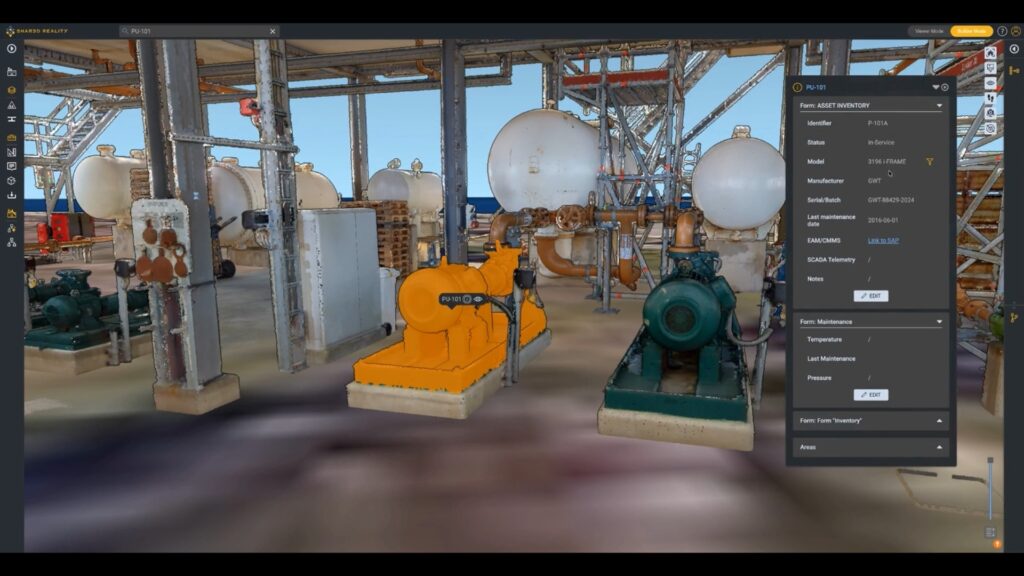
Once objects are interactive, the 3D environment becomes a practical foundation for connecting other information. An asset can be selected, associated with a tag, linked to relevant data or viewed in the context of surrounding equipment.
Crucially, this does not require the entire facility to be manually reconstructed as a detailed CAD model before teams can begin using it. Reality capture provides the visual and spatial foundation; assetization makes that foundation easier to work with.
5. Build on the information systems already in place
Industrial operators already hold significant amounts of asset and engineering information. The challenge is often that this information is distributed across multiple sources and is difficult to interpret without the context of the physical facility.
A maintenance system may tell a planner a great deal about an asset, while a P&ID explains its process context and engineering documents provide further technical detail. What these sources do not always provide is an intuitive view of where the asset is, what surrounds it and what the current installation looks like.
Shared Reality brings those perspectives together without requiring existing systems to be replaced.
For an initial deployment, information can be introduced through straightforward file exchanges. Where more frequent or systematic synchronisation is required, web services and APIs can connect existing CMMS, EAM, ERP and other information sources.
This progressive approach avoids making extensive system integration a condition for getting started. The first use case can connect the information it needs, while additional sources are introduced when there is a practical reason to do so.
6. Enrich the facility according to operational priorities
The same progressive approach applies to tagging and asset information.
There is little value in enriching thousands of objects simply because they exist in the 3D environment. The appropriate level of detail depends on what teams are trying to accomplish.
An asset involved in an upcoming maintenance campaign may require identification, technical attributes and a connection to maintenance information. Equipment elsewhere in the facility may initially need only to provide visual and spatial context.
In the webinar, we discussed three practical ways of introducing tags into Shared Reality: creating them directly, importing them from existing systems such as a CMMS or EAM, and using information available in P&IDs. These methods can be combined according to the information already available.
This makes enrichment a manageable, progressive activity rather than a prerequisite for the entire deployment. Information is added where it contributes to the work, and the Shared Reality becomes richer over time.
7. Use Shared Reality to improve data progressively
Imperfect data is a reality for many brownfield operators. Asset registers may contain gaps, naming conventions may have changed, and engineering documentation may not fully reflect modifications made over decades of operation.
Trying to resolve every discrepancy before deploying Shared Reality would postpone many of the benefits that can help resolve those discrepancies in the first place.
Once existing information is viewed in the context of the physical facility, inconsistencies become easier to understand. Equipment may be visible in the 3D environment but absent from the asset register. A tag may need to be corrected. A P&ID may need to be revalidated against the installed configuration.
Instead of treating these situations as reasons not to start, teams can address them as they encounter them in operational workflows.
This creates a more practical approach to data quality. Rather than a one-off exercise intended to perfect an entire dataset, improvement becomes continuous and focused on the information that matters to ongoing work.
Over time, Shared Reality becomes not only a way to access industrial information, but also a useful environment for making that information more reliable.
8. Make updates part of normal site activity
Capturing a facility once is only the beginning. Industrial sites continue to evolve through maintenance, modifications, revamps and capital projects.
Keeping Shared Reality aligned with those changes does not need to become a separate large-scale exercise.
Much of the information required to maintain it is already being generated through work taking place on the facility.
A contractor preparing a modification may verify equipment and dimensions. A maintenance team may confirm an asset in the field. A revamp may generate new engineering information. An area that has changed can be captured again using photogrammetry or other appropriate reality-capture methods.
When those updates feed back into Shared Reality, each project can leave the shared asset context in a better state than it found it.
The approach to capture can also adapt to the organisation. Some operators may prefer specialist providers, particularly for initial deployments. Others may develop internal scanning capability where updates are frequent. A hybrid approach can support larger multi-site programmes.
What matters is that updating Shared Reality becomes a repeatable process rather than an exceptional event.
9. Scale by repeating what has already worked
By the time Shared Reality has been established for a useful workflow at the first site, much of the work required to scale has already been done.
The organisation has learned how to capture its environment, how assets should be made interactive, which existing information is useful, which teams benefit and how updates can be incorporated into normal operations.
That knowledge becomes a deployment model for the next use case or facility.
The second site does not need to reproduce the first one exactly. Different facilities will have different priorities, systems and levels of data maturity. What can be repeated is the method: establish the physical reality, connect the information required by users, support a meaningful workflow and expand the environment as its use grows.
This is a more practical definition of enterprise scale.
It is not one enormous digital model that must be completed before the organisation can benefit from it. It is a consistent way of giving teams across multiple facilities access to a reliable, shared understanding of their industrial assets.
From one site to a Shared Reality across the enterprise
Scaling Shared Reality does not require perfect data or every enterprise integration to be in place from the beginning.
It requires a useful starting point.
For one organisation, that may be P&ID revalidation. For another, it may be preparing maintenance remotely or creating an asset inventory after taking responsibility for a brownfield facility. The first use case establishes the physical and information foundation; subsequent workflows build on it.
As the facility changes, Shared Reality can change with it. As more information becomes relevant, it can be connected. As more teams see value, access can expand. And when the approach is ready for another facility, the organisation is no longer starting from zero.
This is what makes Shared Reality different from treating the industrial digital twin as a one-off modelling project.
The objective is not to create a perfect digital representation and declare it finished. It is to maintain an accessible, useful connection between the physical facility and the information people rely on to understand and work with it.
Start with one operational need, establish the reality around it, and build from there.
That is a practical path from one industrial site to Shared Reality at scale.
Want to see how it could work for your sites?