Most P&IDs Are Already Outdated. The Industry Knows It.
Ask almost any engineer, maintenance manager, or project team working on a brownfield facility whether their P&IDs perfectly reflect the field. Most will hesitate before answering. Not because they doubt the value of P&IDs. Because they know how difficult it is to keep them aligned with reality.
Across oil and gas, petrochemical, LNG, pharmaceutical, nuclear, and other process industries, facilities evolve continuously. Valves are replaced. Instrumentation is upgraded. Pipework is rerouted. Temporary modifications become permanent. Meanwhile, documentation follows a much slower cycle.
The result is a growing disconnect between what the drawings say exists and what actually exists in the field. This disconnect creates what many operators experience every day: An information gap. A gap between engineering assumptions and operational reality. And that gap becomes increasingly expensive as facilities age
Why P&ID Revalidation Matters
P&IDs remain one of the most important engineering deliverables inside a process facility. They support everything from maintenance planning and hazard studies to process safety reviews, lockout-tagout procedures, turnarounds, Management of Change workflows, and major revamping projects.
In many ways, they are the foundation on which operational, maintenance, and engineering decisions are built. The problem is that this foundation is only as strong as the accuracy of the information it contains.
When P&IDs no longer reflect reality, every activity that depends on them becomes less reliable. Teams spend more time verifying information before acting. Engineering studies require additional site visits. Projects become harder to scope accurately. Contractors submit more variation orders as discrepancies emerge during execution. And perhaps most importantly, risk increases because decisions are being made based on information that teams no longer fully trust.
What begins as a documentation issue quickly becomes an operational issue.
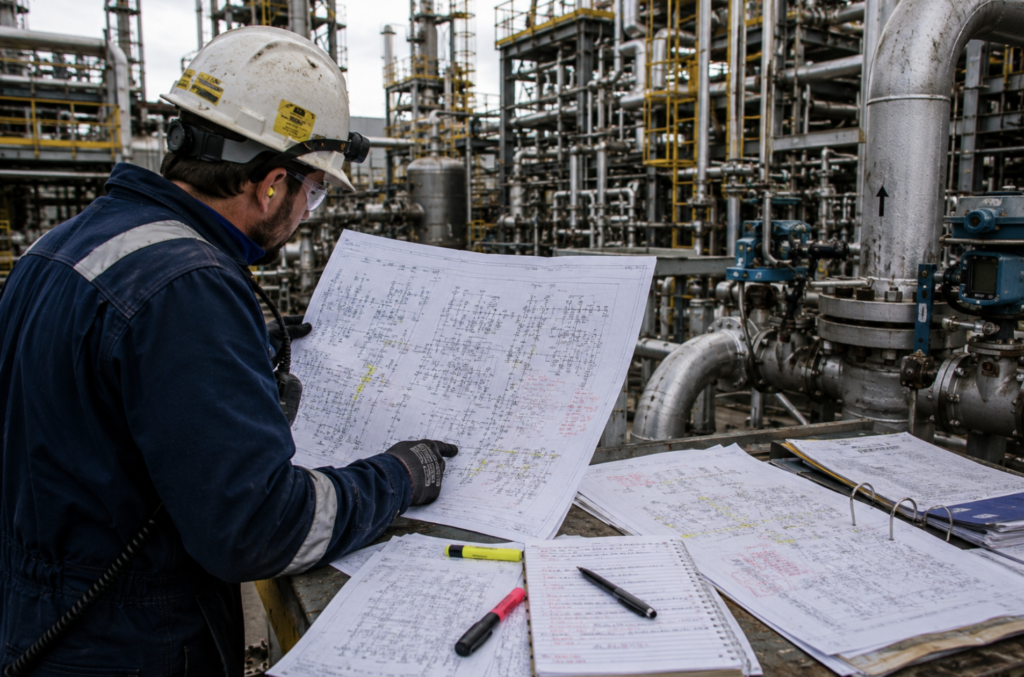
Why Traditional P&ID Revalidation Has Become a Bottleneck
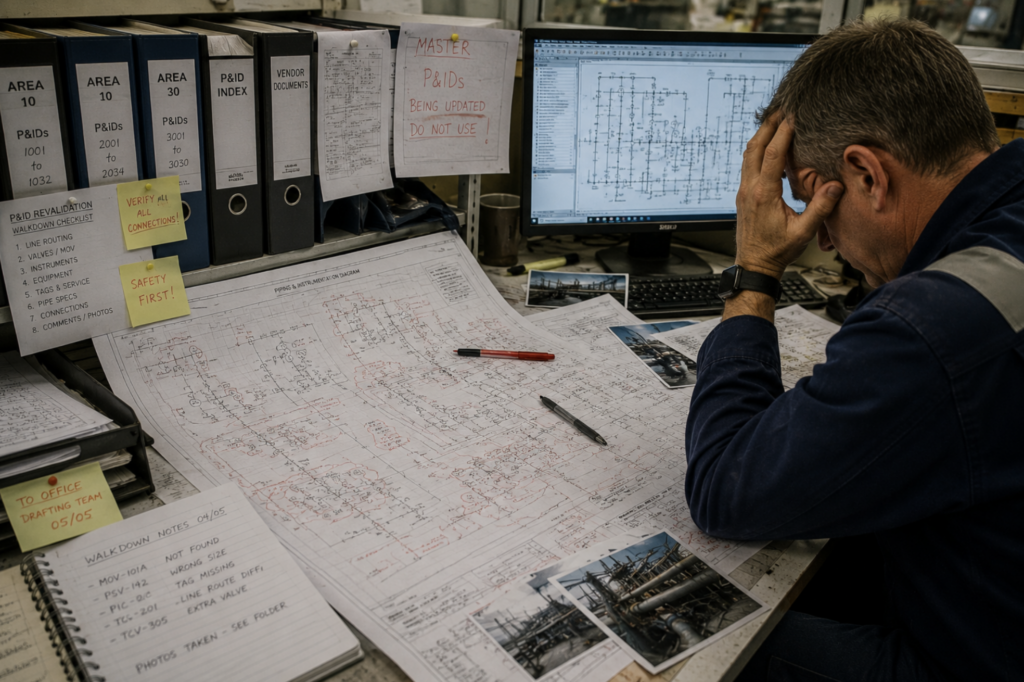
The traditional approach has changed very little over the last decades. Engineering teams launch a P&ID walkdown campaign and technicians enter the field with printed drawings. Discrepancies are marked manually, photos are collected, and drafting teams update the diagrams before review cycles begin.
The process is often lengthy. Weeks become months, and months sometimes become years. By the time updated drawings are issued, new modifications may already have occurred elsewhere on the facility.
This is not a people problem; it is a workflow problem.
The plant evolves continuously, while documentation evolves periodically. Those two clocks run at different speeds, making it increasingly difficult to maintain alignment between P&IDs and the reality of the field over time.
What Is a P&ID Walkdown?
A P&ID walkdown is the process of physically inspecting equipment, piping, valves, and instrumentation in the field and comparing them against the corresponding P&ID.
The objective is to identify discrepancies such as:
- Missing equipment
- Modified piping routes
- Incorrect valve locations
- Unrecorded modifications
- Missing instrumentation
- Incorrect tag references
Walkdowns are effective.
But they are also expensive, time-consuming, and often performed in operating facilities where safety risks must be carefully managed.
Why Do P&IDs Become Outdated?
Several factors contribute to this challenge.
Continuous Field Changes
Facilities rarely remain static, and even well-managed Management of Change processes often struggle to keep pace with years of operational modifications. As changes accumulate over time, maintaining complete alignment between field conditions and technical information becomes increasingly difficult.
Documentation Silos
At the same time, knowledge is frequently distributed across multiple stakeholders, including engineering teams, maintenance teams, contractors, and external drafting organizations. This fragmentation creates documentation silos, making it difficult to maintain a single, consistent view of the facility.
Long Update Cycles
Long update cycles further compound the problem. Many organizations only update documentation following major projects, audits, or regulatory reviews, allowing discrepancies to persist for extended periods before they are identified and corrected.
Retirement of Site Knowledge
Finally, a significant portion of facility knowledge exists inside experienced personnel rather than within formal systems. As these experts retire, undocumented knowledge often disappears with them, creating additional gaps between what is known in practice and what is captured in technical information.
The Industry Is Moving Toward Continuous Revalidation
Instead of treating P&ID revalidation as a large periodic project, leading operators are beginning to treat documentation quality as a continuous process.
The objective changes. Rather than asking, “How do we update thousands of P&IDs every few years?”, organizations are increasingly asking a different question: “How do we continuously reduce the gap between documentation and reality?”
This may appear to be a subtle shift, but it fundamentally changes the workflow.
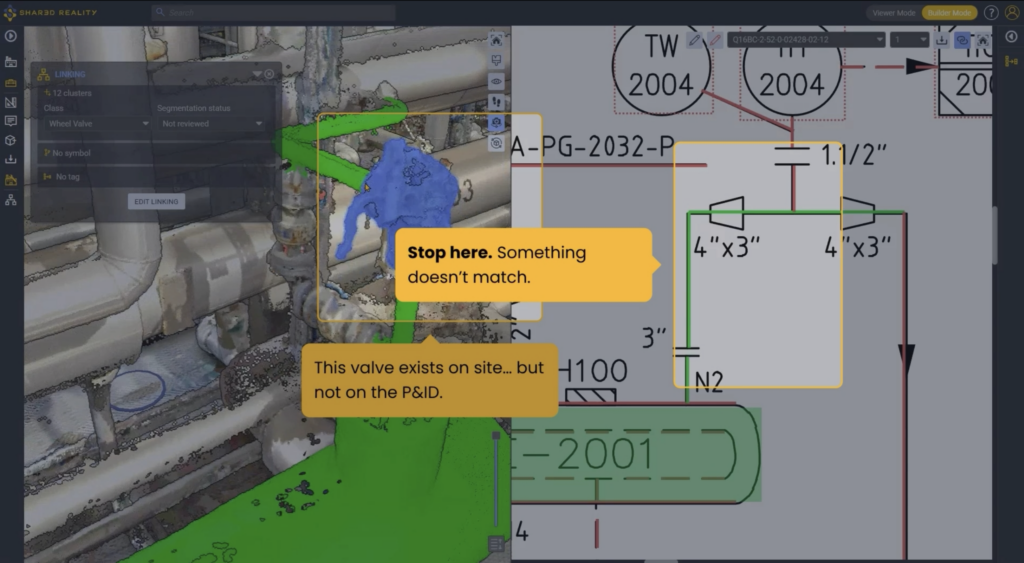
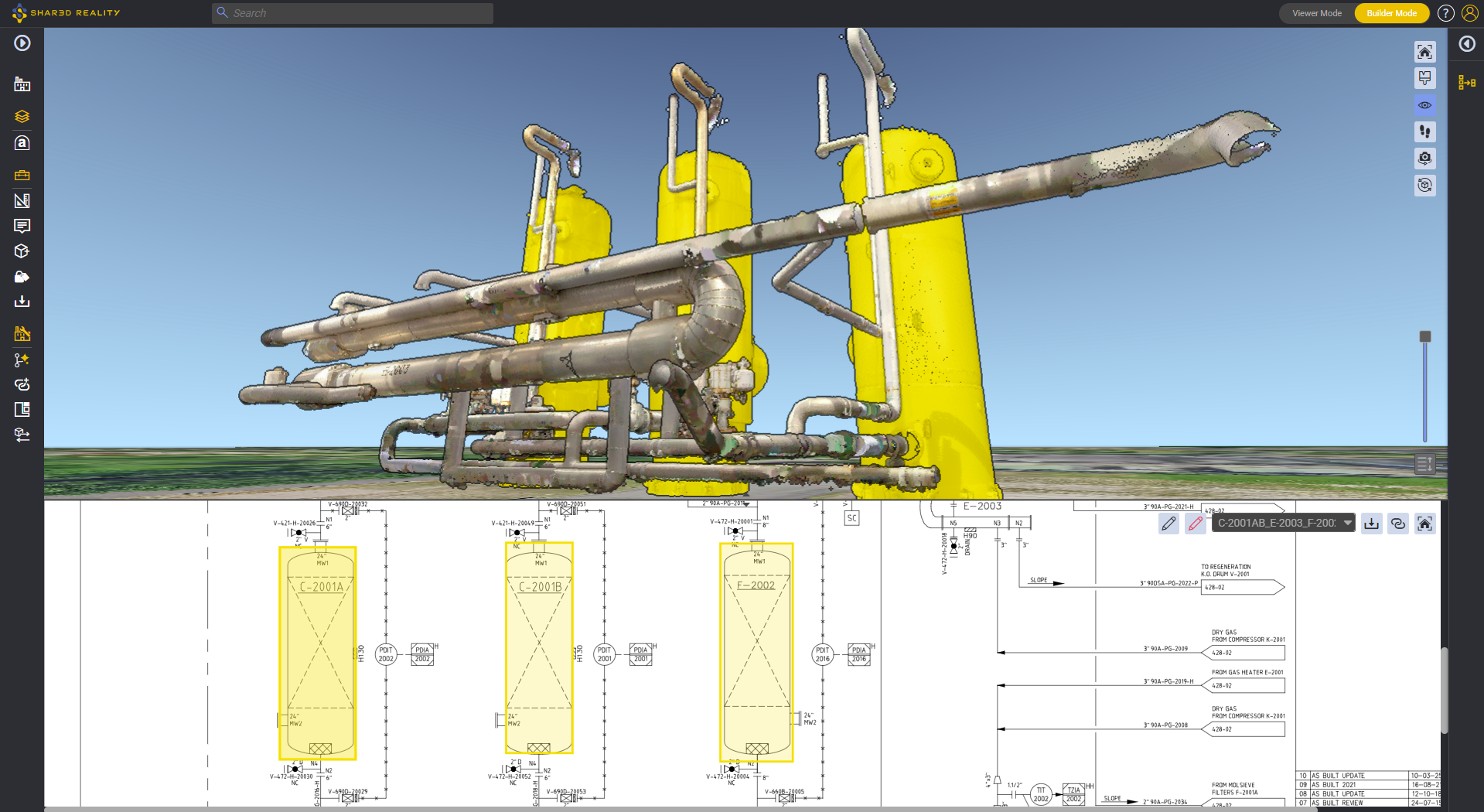
© Samp: Identifying discrepancies between a P&ID and a 3D reality model using Shared Reality
From Plant Walkdowns to Shared Reality
The traditional answer to P&ID revalidation has always been the same: send people back into the field.
When documentation cannot be trusted, engineers perform another walkdown. When a revamp project starts, another walkdown. When a safety study raises questions, another walkdown. The problem is that reality changes continuously, while walkdowns provide only a temporary snapshot.
This is where many digital twin initiatives fall short, as they create another model that must itself be maintained and updated.
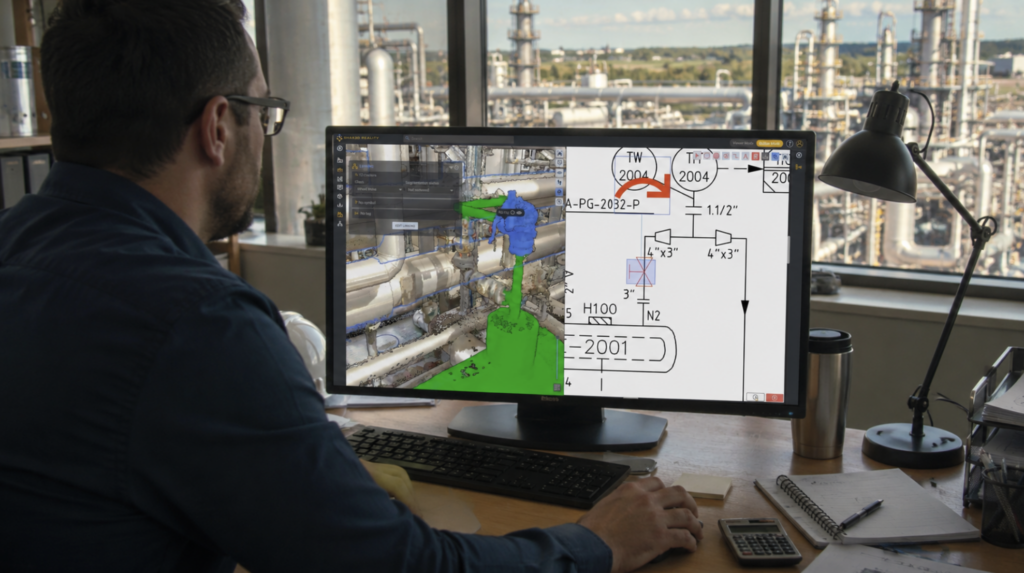
Shared Reality takes a different approach.
Instead of creating a separate representation of the facility, Shared Reality establishes a continuously accessible visual reference built directly from reality capture and connected to existing engineering documentation.
The result is a workspace where engineers, operations teams, contractors, and drafting teams can all work against the same physical reality. P&IDs, equipment registers, photos, annotations, redlines, and 3D reality are no longer isolated sources of information; they become connected views of the same asset.
When discrepancies are identified, they can immediately be linked to the exact location, equipment, piping system, or drawing concerned. When updates are required, teams can validate them against reality before publication. When questions arise, users can navigate directly from the drawing to the field context and back again.
Rather than periodically trying to bring documentation back in sync with the plant, Shared Reality creates a continuous verification loop where documentation and field reality evolve together. For many operators, this represents a shift from periodic revalidation projects to continuous documentation integrity.
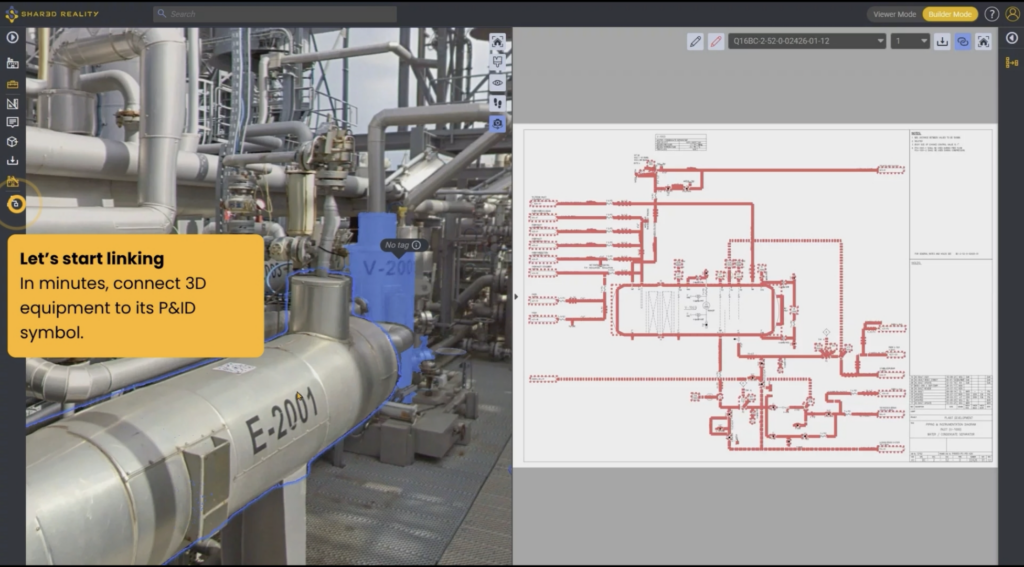
© Samp: Reality and Documentation Side by Side Shared Reality
Crowdsourcing Data Quality Across the Entire Facility
One of the biggest challenges in documentation management is that discrepancies are easy to notice but difficult to report. Operators see them, maintenance technicians see them, and contractors see them, yet many observations never enter formal workflows.
A more effective approach is to make reporting simple. When users can annotate observations directly against a visual representation of the site, discrepancies become easier to capture, prioritize, and resolve.
This transforms documentation quality from an engineering-only responsibility into a shared operational process.
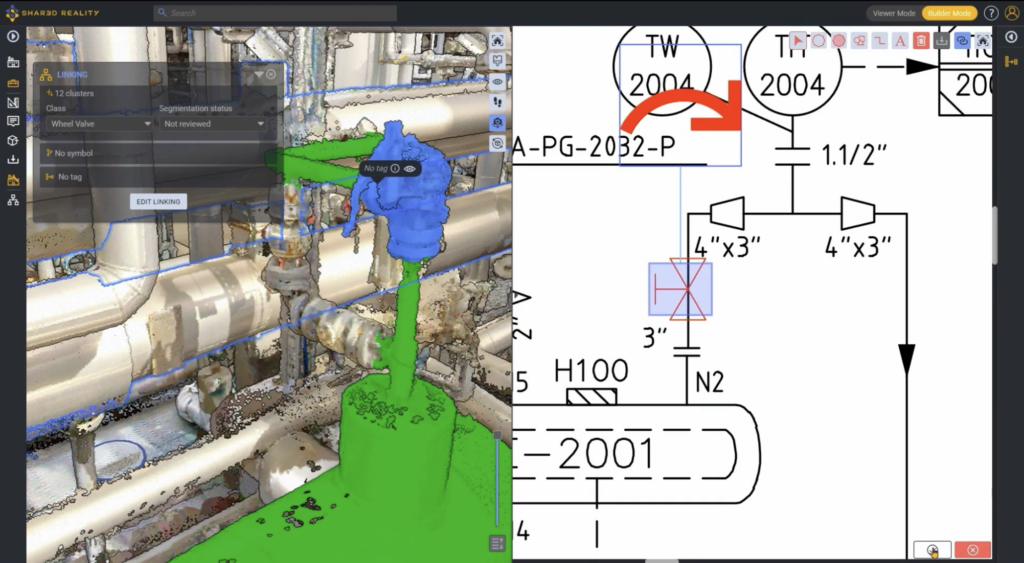
© Samp: Redlining P&ID Documentation in Shared Reality
Linking P&IDs Directly to Reality
Once P&IDs are connected to a 3D representation of the facility, revalidation becomes dramatically more efficient. This is where Shared Reality becomes uniquely powerful.
Engineers can follow piping systems visually, verify connectivity, confirm equipment existence, compare diagrams against field conditions, and redline discrepancies immediately.
Rather than switching between drawings, photographs, spreadsheets, and memory, they work inside a shared visual context.
Virtual P&ID Walkdowns
One of the most significant operational improvements is the ability to perform virtual walkdowns. Instead of physically traversing the facility, teams can validate many aspects of the documentation remotely.
The benefits include reduced site travel, lower safety exposure, faster validation cycles, better collaboration between disciplines, and easier contractor involvement.
For complex facilities, this can significantly reduce the cost of revalidation programs.
Why Drafting Teams Need Context
Traditional drafting teams often receive redlined drawings without sufficient field context, creating ambiguity. Questions arise: Is this the latest revision? Is the redline complete? Has another modification occurred? What exactly changed in the field?
When drafting teams can access the same visual reality context as engineering teams, iteration cycles are reduced and updates become easier to validate before publication.
P&ID Revalidation Doesn’t Need to Take Months Anymore
Facilities continue to change every day. The question is whether your documentation keeps pace.
What once required months of walkdowns, redlining cycles, drafting iterations, and reviews can now be completed in a fraction of the time by connecting P&IDs directly to Shared Reality.
The operators that move fastest are no longer the ones running bigger revalidation campaigns. They are the ones continuously verifying documentation against reality.
See Shared Reality in Action
Watch the guided demonstration and discover how engineering teams are reducing walkdowns, accelerating P&ID revalidation, and turning documentation accuracy into an ongoing operational advantage.
Get Started
Try the guided interactive demo
Frequently Asked Questions
How often should P&IDs be revalidated?
The traditional answer is every few years or before major projects. Increasingly, operators are moving toward continuous validation through ongoing discrepancy identification and resolution.
What is the biggest challenge in P&ID revalidation?
Finding discrepancies is often less difficult than coordinating their resolution through multiple teams and systems.
Can P&ID revalidation be performed remotely?
Many validation activities can now be performed remotely when P&IDs are linked to an accurate 3D representation of the facility.
How does Management of Change relate to P&ID updates?
P&ID updates are a critical output of the Management of Change process, ensuring engineering documentation remains aligned with approved modifications.