When a turnaround, revamp, or modification project is approved, most teams assume the work begins with engineering.
In reality, it usually begins with validation.
Before engineers can design tie-ins, before contractors can estimate work packages, and before maintenance teams can prepare isolations, one question inevitably emerges:
Can we trust the existing documentation?
For brownfield facilities, this question is rarely trivial. Years of maintenance activities, equipment replacements, shutdown modifications, and operational changes can gradually create a disconnect between engineering drawings and field reality.
The result is familiar to anyone involved in project execution: before the future can be designed, the present must first be understood.
This is why P&ID revalidation has become an increasingly important part of project preparation. Not because operators suddenly decide to improve documentation, but because successful projects depend on an accurate understanding of existing conditions.
Every Brownfield Project Pays the “Information Tax”
Unlike greenfield developments, brownfield projects are constrained by what is already installed.
Before any meaningful engineering work can start, teams must confirm what is actually installed in the field. Tie-in locations need verification. Isolation boundaries need confirmation. Equipment interfaces must be checked. Assumptions that appear straightforward on a drawing often require validation on site.
When documentation is not fully aligned with reality, projects begin paying what many organizations quietly accept as the “brownfield tax”: the time, cost, and effort required to rediscover information that should already exist.
Additional walkdowns are organized. Engineering queries multiply. Contractors revisit units. Design assumptions are checked and rechecked. Valuable project time is consumed simply establishing a reliable baseline.
Most project teams accept this as normal.
Increasingly, however, operators are asking a different question:
Can this effort be turned into a lasting asset rather than a recurring cost?
Why Projects Create the Right Conditions
Documentation improvement initiatives often struggle because they compete with operational priorities. Production targets, inspections, maintenance activities, and regulatory obligations understandably take precedence.
Projects create a different dynamic.
Once a turnaround, revamp, reliability upgrade, or capital modification is approved, resources are mobilized, contractors are engaged, and deadlines become fixed. Activities that may have been difficult to justify previously become essential because uncertainty now carries a direct cost.
This makes projects the ideal trigger for P&ID revalidation.
The verification work is already required. The engineering resources already exist. The budget is already available.
Rather than launching a separate revalidation program, many operators are integrating P&ID verification directly into project preparation. The same effort used to prepare the project can simultaneously improve the quality of engineering records for the future.
One investment delivers two outcomes: a better-prepared project and a stronger information baseline.
Capturing Value from Work That Is Already Happening
Perhaps the strongest business case for project-driven revalidation is that much of the work is already taking place.
Engineering contractors routinely verify field conditions before issuing designs. Construction teams validate installation constraints. Turnaround specialists review work packages and isolation requirements. Throughout the project lifecycle, people continuously generate knowledge about the facility.
Historically, much of that knowledge has remained fragmented across reports, spreadsheets, markups, emails, and individual experience. When the next project begins, many of the same questions are asked again because previous findings were never fully integrated into the facility’s engineering records.
This is one of the reasons reality capture and Shared Reality approaches are gaining traction across the process industries.
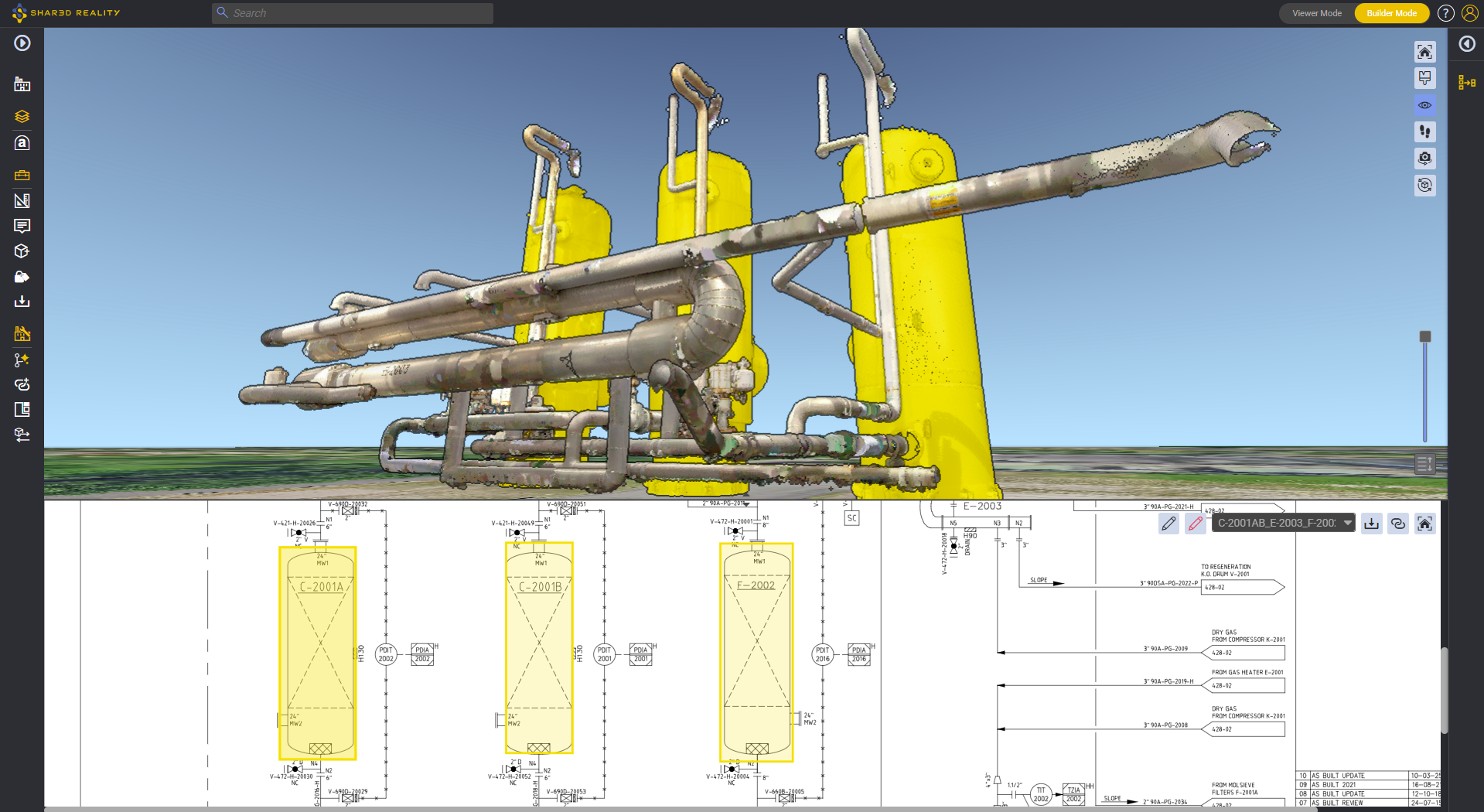
Rather than relying exclusively on physical walkdowns, operators can increasingly compare P&IDs against current site conditions within a shared visual environment. Contractors, owner teams, maintenance specialists, and operations personnel can review the same context, identify discrepancies, and contribute to a common understanding of the facility.
The objective is not to eliminate field validation. Physical verification remains essential.
The objective is to reduce unnecessary repetition and ensure that knowledge generated during projects remains valuable long after the project has finished.
From Project Deliverable to Operational Asset
One of the recurring frustrations in brownfield projects is that valuable knowledge often disappears when the project ends.
Field observations remain buried in reports. Verification notes stay inside contractor files. Lessons learned rarely become part of the organization’s long-term knowledge base.
As a result, future projects often repeat the same verification exercises and continue paying the same information tax.
A more sustainable approach is to treat project preparation as an opportunity to improve the facility’s information assets.
When discrepancies are identified, reviewed, and validated during project execution, the resulting knowledge can be retained rather than lost. Future project teams inherit a cleaner baseline. Maintenance planners spend less time resolving uncertainties. Operations teams gain access to more reliable documentation.
Instead of repeatedly rediscovering the same information, the organization progressively builds confidence in its engineering records.
A Simpler Path to MOC Closure
The benefits continue after construction is complete.
Traditionally, one of the most challenging phases of a modification project is ensuring that engineering documentation accurately reflects the final installation. As-built updates, drawing revisions, and Management of Change (MOC) activities can continue long after physical work has ended.
Many operators are now exploring a simpler approach.
Instead of relying exclusively on manual documentation updates or costly modelling exercises, modified areas can be rescanned and compared against approved project documentation. Redlined P&IDs generated during project preparation remain connected to the updated reality of the facility.
The result is a more direct path from execution to documentation.
Rather than treating engineering updates as a project afterthought, information integrity becomes embedded within the project lifecycle itself. This aligns naturally with the objectives of Management of Change: ensuring that the physical asset, engineering records, and operational understanding remain synchronized.
More Than a Documentation Exercise
It is tempting to view P&ID revalidation as a documentation task.
In reality, it is a project risk reduction activity.
The objective is not simply to correct drawings. The objective is to reduce uncertainty before engineering decisions are made, before materials are ordered, before contractors are mobilized, and before shutdown windows begin.
This is why more operators are beginning to see project preparation and P&ID revalidation as closely connected activities. One prepares the work ahead. The other improves the information used to prepare it.
Together, they help deliver safer execution, fewer surprises, greater efficiency, and a faster return to operations.
Viewed from that perspective, P&ID revalidation is not a separate initiative that sits alongside brownfield projects.
It is often the very first step.